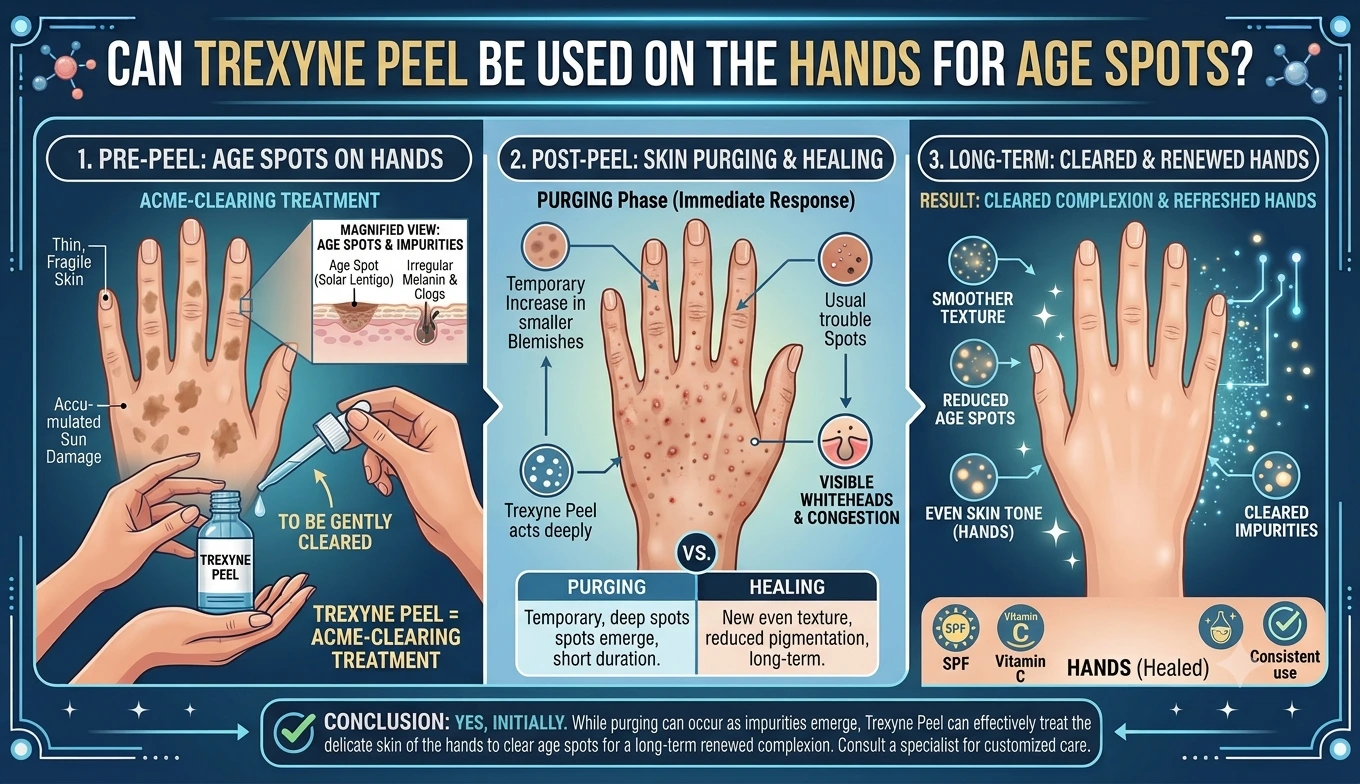
Can Trexyne Peel Be Used on the Hands for Age Spots?
Yes, Trexyne Peel can be used on the hands to help address the appearance of age spots, provided the treatment is carried out by a trained practitioner. The hands are one of the most visible areas where sun exposure and years of daily use show up as pigmentation, roughness and a duller skin tone. Because Trexyne Peel works through a mechanical resurfacing action using marine-algae spicules, rather than any chemical exfoliant, it offers a controlled way to support renewal on this delicate and often overlooked area. Practitioners can review the full product details on the Trexyne Peel product page before adding hand treatments to a client’s plan. This article explains why age spots form on the hands, how a mechanical resurfacing treatment differs from other approaches, and what practitioners should consider when treating this area.
Why Age Spots Appear on the Hands
The backs of the hands are exposed to the sun almost as often as the face, yet they rarely receive the same level of protection or aftercare. Over time, this cumulative exposure leads to an uneven build-up of pigment in the upper layers of the skin, which shows up as flat, darker patches often called age spots or sun spots.
Skin on the hands is also thinner than facial skin in many areas, with less underlying fat and a lower concentration of oil glands. This means pigmentation changes can appear more pronounced and the skin surface can look rougher or more textured than on the face. Clients often notice these changes gradually, then become more concerned about them as the contrast with surrounding skin becomes clearer.
The pattern of pigmentation on the hands also tends to differ from the face. Rather than smaller, scattered marks, hand pigmentation often presents as larger, flatter patches concentrated across the knuckles and the back of the hand, where sun exposure is most direct and consistent over the years. This distribution is worth noting during consultation, as it can influence how a practitioner approaches the treatment plan.
Common Contributing Factors
Several factors tend to combine to create visible pigmentation on the hands:
- Repeated, unprotected sun exposure over many years
- Reduced skin thickness and slower surface renewal with age
- Inconsistent use of hand cream or SPF compared with facial skincare routines
- General wear from frequent washing, driving and outdoor activity
- A natural slowing of the skin’s own cell turnover process as clients get older
Understanding these factors helps practitioners set realistic expectations with clients before any resurfacing treatment begins. It also helps frame the conversation around maintenance, since many of these contributing factors continue after treatment unless a client adjusts their daily habits.
Why the Hands Are Often Neglected in Skincare Routines
Most clients invest heavily in a facial skincare routine, yet very few extend the same care to their hands. Cleansers, serums, moisturisers and SPF are usually reserved for the face and neck, while the hands are left to fend for themselves.
This imbalance in daily care is one of the main reasons pigmentation on the hands tends to look more advanced than on the face, even in clients who are diligent about their skincare elsewhere. When a client finally seeks a professional opinion, the hands have often had years of exposure with minimal targeted support.
There is also a practical reason the hands are neglected. Facial skincare products are applied in a controlled setting, usually in front of a mirror as part of a morning or evening routine, while hand cream and SPF are more easily forgotten during a busy day. Even clients who are highly consistent with facial care will often admit, when asked directly, that they rarely reapply anything to their hands after the first application in the morning.
This is exactly where an in-clinic resurfacing option becomes valuable. Rather than relying on inconsistent home habits, a structured treatment plan built around a professional-grade product gives practitioners a way to address years of neglect in a controlled setting. It also gives practitioners an opportunity to educate clients on why their hands may be showing more visible signs of ageing than their face, which can open a useful conversation about ongoing home care.
Many clients only become aware of the gap between their facial and hand skincare once it is pointed out during a professional consultation. This is a useful moment for practitioners, as it often leads to a broader conversation about long-term skin health and the value of treating the hands as seriously as the face, rather than as an afterthought.
What Makes Trexyne Peel Different From a Chemical Approach
Trexyne Peel is not a chemical peel. It contains no acids and does not work through chemical exfoliation. Instead, it uses marine-algae spicules to create controlled micro-channels on the skin’s surface through a purely mechanical mechanism. This distinction matters for areas like the hands, where skin can be thinner and more reactive than the face.
Because there is no chemical penetration involved, the treatment experience tends to be more predictable. The stabilised Vitamin E included in the formula supports the skin’s recovery phase from the first application, which is a helpful consideration when working on an area that clients use constantly in daily life.
For practitioners who are used to explaining chemical peels to clients, the mechanical mechanism behind Trexyne Peel can actually make client conversations simpler. There is no need to discuss pH levels, acid strength or penetration depth. Instead, the explanation centres on marine-algae spicules physically creating micro-channels to support renewal, which many clients find easier to understand and feel reassured by.
A Tiered Protocol for a Sensitive Area
One of the practical advantages of Trexyne Peel is its tiered protocol. This allows a practitioner to match treatment intensity to the client’s skin type and to what they expect in terms of downtime. On the hands, where healing time can affect a client’s ability to work or carry out daily tasks, this flexibility is particularly useful.
A tiered approach also allows practitioners to treat the hands more conservatively than they might treat the face, particularly for a first session, and then step up intensity gradually as they learn how an individual client’s skin responds. This kind of gradual escalation is a sensible way to introduce hand treatments into an existing client relationship without introducing unnecessary risk.
Practitioners considering this approach for hand treatments can browse the full range on the Trexyne shop page to see the available pack sizes and plan a course of treatments accordingly.
How a Mechanical Resurfacing Treatment May Support Hand Pigmentation
When marine-algae spicules create micro-channels on the surface of the skin, this can help encourage the natural renewal process. As the outer, pigmented surface cells are gradually addressed, fresher skin is supported underneath. Over a course of treatments, this may help contribute to a more even-looking skin tone on the hands.
It is important to set clear expectations with clients. Results vary from person to person, and outcomes depend on factors such as the depth of pigmentation, how long the spots have been present, and how consistently a client protects their skin with SPF between sessions. A mechanical approach can support the skin’s own renewal process, but it should always be positioned as part of a wider skincare strategy rather than a single fix.
It also helps to explain to clients that skin renewal is a gradual biological process. Even with consistent treatment, visible improvement tends to appear over the course of several weeks following a session, as the skin works through its natural renewal cycle. Setting this timeline expectation from the outset avoids clients feeling disappointed by the pace of change.
Assessing a Client’s Hands Before Treatment
A thorough consultation is essential before treating the hands. Practitioners should look closely at the thickness and condition of the skin, the depth and distribution of pigmentation, and any signs of sensitivity or previous treatments in the area.
It is also worth examining the backs of the hands under good lighting, ideally with the client’s hands both relaxed and gently stretched, as pigmentation can sometimes look different depending on how the skin is positioned. Comparing both hands side by side can also help identify whether one hand shows more pronounced pigmentation, which is common in clients whose dominant hand has had more sun exposure over the years, for example through driving.
Questions Worth Asking During Consultation
- How long have the pigmented areas been present?
- Has the client had any previous resurfacing or cosmetic treatments on their hands?
- What is their typical sun exposure and SPF habit?
- Do they have any conditions that might affect healing time?
- What downtime can they realistically manage given their daily routine?
- Do they use their hands for manual or repetitive tasks at work that could affect healing?
This information helps determine where on the tiered protocol a client’s treatment should sit, and whether a course of sessions is more appropriate than a single treatment. It also gives the practitioner a clearer picture of how realistic it is for the client to follow aftercare advice consistently.
A thorough consultation should also cover the client’s general lifestyle and occupation. Someone who works outdoors, drives long distances regularly or spends a lot of time gardening will have different ongoing sun exposure risks compared with someone who works mostly indoors. This context helps a practitioner give more tailored advice about maintenance and realistic long-term expectations, rather than offering generic guidance that may not suit the client’s actual daily life.
It is also worth discussing any hand creams, retinol-based products or other topical routines the client may already be using, since this gives a fuller picture of how their skin has been supported in the recent past and whether any adjustments to their existing routine might complement the in-clinic treatment plan going forward.
Building a Treatment Plan for the Hands
Because pigmentation on the hands often builds up over many years, a single session is unlikely to address it fully. Most practitioners find that a structured course, spaced appropriately to allow for the skin’s recovery phase between sessions, gives a more considered and sustainable result.
When planning a course, it helps to document the condition of the hands with photographs at each visit. This gives both the practitioner and the client a clear record of how the skin is responding over time and helps inform decisions about pacing and intensity as the course progresses. Photographs taken in consistent lighting and hand positioning make it far easier to track subtle changes that might otherwise be difficult to notice session by session.
Spacing Sessions Appropriately
The predictable downtime associated with Trexyne Peel makes it easier to plan a realistic schedule with clients. Because the tiered protocol allows intensity to be adjusted, practitioners can start conservatively on the hands, particularly if this is a new area of treatment for a returning client, and increase intensity in later sessions if appropriate.
Many practitioners find it useful to align hand sessions with a client’s existing facial treatment schedule, so both areas progress through a course together. This can simplify planning for the client and helps build a consistent treatment habit, rather than treating the hands as an afterthought booked separately.
Aftercare Considerations Specific to the Hands
Aftercare on the hands presents a unique challenge compared with the face. Clients use their hands constantly throughout the day, for washing, working, driving and general activity, which means the treated skin is rarely left undisturbed.
Practitioners should give clear, practical aftercare guidance that accounts for this. This typically includes advice on:
- Avoiding unnecessary friction or harsh soaps on treated skin in the days following treatment
- Applying SPF diligently once the skin has moved past the initial recovery phase
- Being mindful of activities that involve prolonged sun exposure, such as driving or gardening
- Reporting any unexpected changes promptly
- Wearing gloves for household or manual tasks that involve repeated contact with water or cleaning products, if practical
Because the mechanism behind Trexyne Peel is mechanical rather than chemical, aftercare can be explained to clients in straightforward terms, without needing to discuss chemical exfoliation or acid-related sensitivities. This tends to make clients feel more confident about resuming normal hand use sooner, once the practitioner has confirmed it is appropriate to do so.
It is also worth giving clients a written aftercare summary they can refer back to, since verbal instructions given immediately after a hand treatment are easily forgotten once the client returns to their daily routine.
Some practitioners find it helpful to check in with clients a few days after a hand treatment, either by phone or message, particularly for clients being treated on this area for the first time. This gives an opportunity to answer any questions about what is a normal part of the recovery phase and to catch any concerns early, before the client’s next scheduled visit.
Setting Realistic Client Expectations
Age spots that have built up over decades will not disappear after one visit, and it is important that practitioners communicate this clearly from the outset. Framing the treatment as a supportive part of an ongoing skincare strategy, rather than an instant transformation, helps manage expectations and builds trust.
Clients should understand that consistent sun protection between sessions plays a significant role in how well results are maintained. A course of treatments can help support a more even-looking complexion on the hands, but ongoing daily care is what helps preserve that improvement over time.
It can help to frame this conversation around long-term skin health rather than a single cosmetic outcome. Clients who understand that their hands need the same level of ongoing care as their face tend to be more consistent with sun protection afterwards, which supports better maintenance of results over the months following a course of treatment.
How Hand Treatment Timelines Compare With Facial Treatment
Practitioners who are experienced with facial resurfacing sometimes assume the hands will follow an identical timeline, but there are a few practical differences worth considering. The skin on the hands is exposed to friction, water and temperature changes throughout the day in a way the face rarely is, which can influence how the skin feels during the recovery phase between sessions.
This does not mean the hands take longer to respond to treatment, but it does mean the day-to-day experience of recovery can feel different for clients. Some clients find that visible signs of the recovery phase are more noticeable on the hands simply because they look at their hands more often during normal daily tasks, such as typing, cooking or driving. Talking clients through this difference in advance helps avoid unnecessary concern.
It is also worth noting that clients often reach a point where their hands and face are on different points of a treatment course, particularly if hand treatments were introduced partway through an existing facial programme. Keeping clear notes on where each area sits within its own tiered protocol helps avoid confusion when planning future appointments, especially in a busy clinic with several ongoing client programmes.
Coordinating Multi-Area Treatment Plans
For clients being treated on both the face and hands, it is worth considering how the two areas interact from a scheduling perspective. Some practitioners prefer to stagger sessions so that only one area is in its recovery phase at a time, which can make aftercare easier for the client to manage. Others find that treating both areas in the same visit suits clients better, particularly those travelling some distance to the clinic.
There is no single correct approach here. The right choice depends on the client’s skin, their lifestyle and how much downtime they can realistically accommodate across both areas at once. A clear treatment plan, discussed and agreed with the client in advance, helps avoid any confusion about what to expect between visits.
Why Professional-Only Access Matters for Hand Treatments
Trexyne Peel is sold strictly to verified practitioners and clinics, and this professional-only access is particularly relevant when treating an area like the hands. The skin here can vary significantly in thickness and condition between clients, and a trained eye is needed to assess suitability and select the appropriate intensity from the tiered protocol.
This professional oversight also means that any questions about supply, training or protocol can be directed to the brand directly. Practitioners who want to discuss how to incorporate hand treatments into their existing service menu are encouraged to reach out via the Trexyne contact page for further guidance.
Keeping this treatment within professional hands also protects clients from attempting a similar approach without proper training or equipment. The tiered protocol and consultation process are designed to be led by a trained practitioner who understands how to read the skin and adjust intensity accordingly, which is not something that can be safely replicated outside a clinical setting.
Incorporating Hand Treatments Into a Wider Clinic Offering
For clinics already using Trexyne Peel on the face, extending the treatment to the hands can be a natural addition to a client’s overall skincare plan. Many clients who invest in facial resurfacing are receptive to the idea of treating their hands once they understand the option exists, particularly if their hands show visible signs of ageing that contrast with a more refined facial complexion.
Introducing hand treatments as an add-on during a facial consultation is often an effective way to raise awareness, since clients may not have considered their hands as an area worth treating until it is pointed out to them. Some clinics find it helpful to offer a short course of hand treatments alongside a client’s existing facial programme, which can improve overall client satisfaction and support longer-term retention.
Practitioners can find more information on the brand’s approach and full treatment range on the Trexyne homepage, which is a useful resource to share with clients who want to understand the philosophy behind the treatment before booking.
Conclusion
Age spots on the hands develop gradually, driven mainly by years of sun exposure combined with thinner skin and inconsistent daily care compared with the face. Because this area is used constantly and often overlooked in skincare routines, pigmentation can become more noticeable over time. Trexyne Peel offers practitioners a mechanical, non-chemical approach to resurfacing the hands, using marine-algae spicules to support the skin’s natural renewal process, with stabilised Vitamin E supporting recovery from the first application. With a thoughtful consultation, a well-paced treatment course and clear aftercare guidance, this approach may help support a brighter, more even-looking complexion on the hands over time.
FAQ
Q: Can Trexyne Peel be used to treat age spots on the hands?
Yes, when carried out by a trained practitioner. Trexyne Peel works through a mechanical resurfacing action that may help support a more even-looking skin tone on areas such as the hands, where pigmentation from sun exposure is common.
Q: How many sessions are usually needed to see an improvement in hand pigmentation?
This varies depending on the depth and duration of the pigmentation, as well as individual skin response. Most practitioners plan a course of several sessions, spaced to allow the skin’s recovery phase between each treatment.
Q: Is Trexyne Peel a chemical peel for hand pigmentation?
No. Trexyne Peel contains no acids and does not work through chemical exfoliation. It uses marine-algae spicules to create controlled micro-channels through a purely mechanical mechanism.
Q: Is treating the hands with Trexyne Peel more sensitive than treating the face?
Skin on the hands can be thinner in some areas, so practitioners typically start with a lower intensity from the tiered protocol and adjust based on how the skin responds over subsequent sessions.
Q: Can I use Trexyne Peel on my own hands at home?
No. Trexyne Peel is designed for use exclusively by trained aesthetic professionals and is sold strictly to verified practitioners and clinics, not for home use.
Q: What can clients do between sessions to help maintain results on their hands?
Consistent SPF use and gentle daily care play an important role in maintaining an even-looking skin tone between treatments. Practitioners should provide clear aftercare guidance tailored to how often clients use their hands throughout the day.
Q: Does Trexyne Peel completely remove age spots on the hands?
No treatment can guarantee complete removal of long-standing pigmentation. Trexyne Peel may help support the skin’s natural renewal process and contribute to a more even-looking complexion over a course of treatments, but results vary between individuals.