What Does a Trexyne Peel Treatment Feel Like?
For anyone considering a Trexyne Peel for the first time, the question of what it actually feels like during and after the treatment is entirely reasonable to ask. Professional resurfacing has a reputation, not always deserved, for being uncomfortable, unpredictable, or involving significant downtime that disrupts normal life. The Trexyne Peel experience is deliberately different. The treatment works through a mechanical resurfacing mechanism using marine-algae spicules, with no chemical agents involved at any stage. What clients typically describe during the session is a mild tingling or warmth, a sensation of gentle surface contact rather than anything sharp or burning. Recovery tends to be manageable and follows a predictable pattern that the practitioner will have briefed you on in advance. The Trexyne Peel is designed around the principle of no surprises, and that principle extends to the sensory experience of the treatment itself as much as to the recovery that follows it.
Before the Treatment Begins
The experience of a Trexyne Peel session starts before the treatment itself, at the consultation and assessment that take place before any resurfacing begins. A trained practitioner will assess the skin’s current condition, review the client’s history and any relevant medications or skincare products, and determine the appropriate intensity within the tiered protocol for this particular session.
For first-time clients, this assessment is also an opportunity for the practitioner to explain exactly what the treatment involves, what sensations to expect, how the recovery period will progress, and what aftercare will be needed. Clients who are well informed before the session begins have a significantly more relaxed and positive experience than those who arrive without knowing what to expect.
On the day of the treatment, the practitioner will cleanse the skin thoroughly before applying the Trexyne Peel. This removes any product residue, excess sebum, and environmental debris that could interfere with the treatment’s contact with the skin surface. The cleansing step is usually gentle and sets a comfortable, clinical tone for the session.
The Sensation During Application
The sensation that clients most commonly describe during a Trexyne Peel session is a mild tingling or warming feeling across the treated area. This reflects the skin’s response to the mechanical micro-channels being created by the marine-algae spicules as the treatment is applied.
The sensation is generally mild and well tolerated. It is not the burning or stinging associated with treatments that involve a chemical reaction in the skin. Because the Trexyne Peel achieves its resurfacing effect through physical rather than chemical action, the experience during the session tends to be noticeably different from what clients may have encountered with other types of professional resurfacing.
Some clients describe a slight warmth or a buzzing sensation in the treated area, particularly in zones where the skin is thinner or more sensitive, such as around the nose or near the hairline. This warmth is a normal response to the micro-channelling process and does not indicate that anything is going wrong. It typically settles within minutes of the application being completed.
Clients with more sensitive skin, or those receiving a higher-intensity session later in a treatment course, may notice a more pronounced tingling during application. This is within the expected range for mechanical resurfacing and should be communicated to the practitioner in real time if it feels stronger than expected, so that they can assess and adjust accordingly.
What to Tell Your Practitioner During the Session
Good communication during the session supports a better outcome. Clients should feel comfortable telling the practitioner if the sensation feels stronger in a particular area, if they experience any unexpected discomfort, or if they feel the treatment is more intense than expected. A practitioner using the Trexyne Peel’s tiered protocol has the flexibility to adjust the approach mid-session based on real-time feedback, which is one of the practical advantages of a mechanical resurfacing treatment.
There is no need to stay silent through a resurfacing session out of a desire to seem like a good patient. The practitioner’s ability to make the session both comfortable and effective is directly supported by what the client tells them during the appointment.
Immediately After Application: What the Skin Feels Like
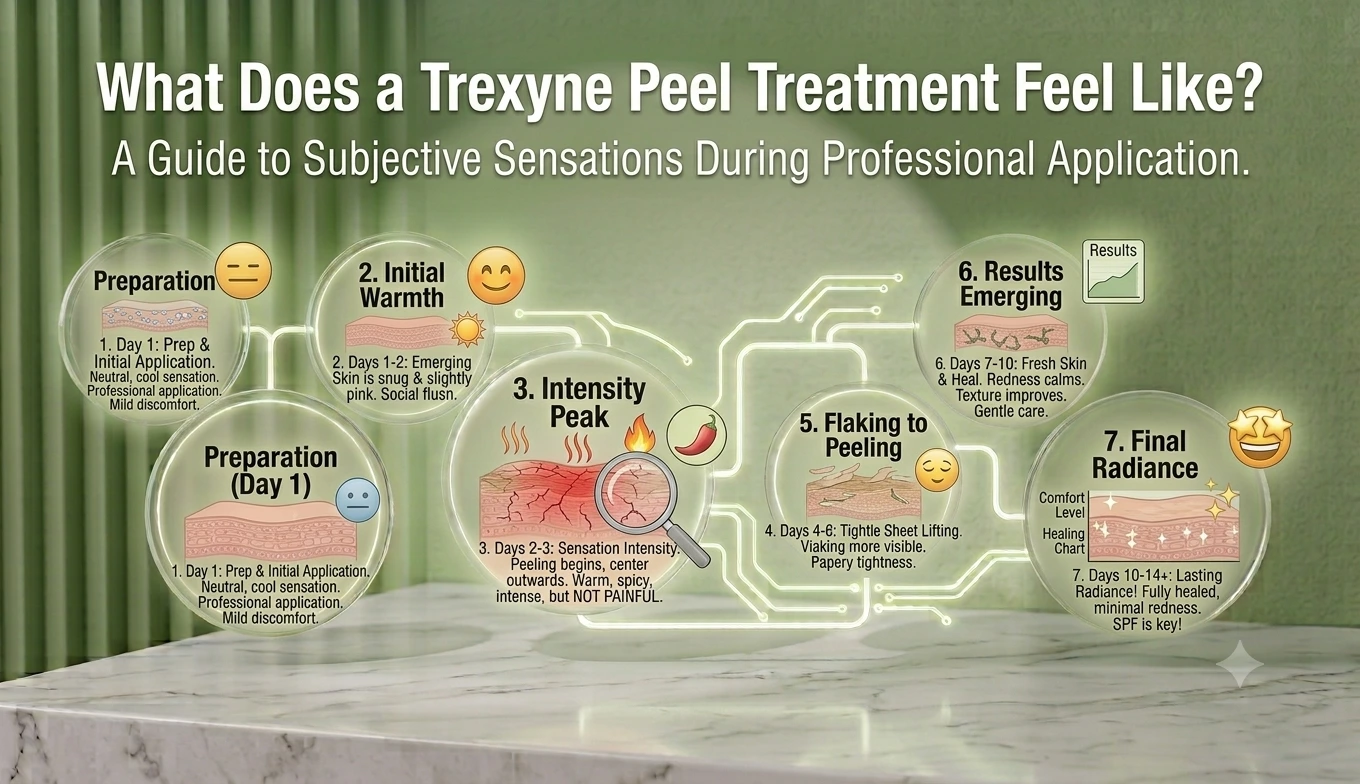
Once the treatment has been applied and the session is complete, the skin will typically feel warm, tight, and mildly sensitive to the touch. This immediate post-treatment sensation is a normal and expected response to the resurfacing stimulus and reflects the beginning of the skin’s repair response.
The practitioner will apply any appropriate post-treatment product to the skin before the client leaves, which helps support the initial recovery phase and reduces the intensity of the immediate post-treatment warmth and tightness. For the Trexyne Peel, the stabilised Vitamin E in the formulation is designed to support the recovery phase from the very first application, contributing to a more settled post-treatment sensation than clients might experience with treatments that offer no recovery support.
Many clients describe a feeling of tightness similar to the skin feeling slightly sunburned, without the pain or severity of an actual sunburn. The skin may look noticeably flushed in the minutes and hours immediately following the session, which is again a normal part of the early repair response.
Most clients are comfortable leaving the clinic and returning to normal activities immediately after the session, provided they follow the aftercare guidance given by the practitioner. The immediate post-treatment experience of the Trexyne Peel is designed to be manageable rather than debilitating, reflecting the treatment’s commitment to predictable downtime.
The First 24 to 48 Hours: What to Expect
In the first day or two after a Trexyne Peel session, the skin typically continues to feel tight and may appear flushed. This phase reflects the skin actively working through the initial stage of its repair response, with increased blood flow to the treated area driving the visible redness.
The skin during this window is more sensitive than usual to external stimulus. Hot water, temperature extremes, vigorous rubbing, and active skincare ingredients can all feel more irritating than they would on settled skin. This is why the aftercare guidance to use lukewarm water only, keep the routine stripped back, and avoid heat sources is so important during these first two days.
Some clients experience a slight feeling of dryness or flakiness beginning from the second day, as the outermost skin layers that have been disrupted by the resurfacing begin to prepare to shed. This is a normal and positive sign that the renewal process is underway.
Applying the fragrance-free moisturiser recommended in the aftercare routine helps manage this dryness and supports the barrier during the recovery phase. The skin should be kept hydrated without being overloaded, and SPF should be applied every morning without exception throughout the recovery period and beyond.
Days Three to Five: The Shedding Phase
The most visible part of the Trexyne Peel recovery typically occurs between days three and five for most clients at moderate intensity. During this phase, the outer skin layers that were disrupted by the resurfacing shed gradually, revealing the fresher, more refined skin beneath.
This shedding is not the dramatic, sheet-like peeling associated with deeper or more aggressive treatments. For most clients receiving a Trexyne Peel at a moderate intensity, the shedding presents as light flaking, similar to mild dry skin, that is more noticeable when the skin catches the light than when viewed straight on. The skin may feel slightly rough or uneven during this phase as the surface cells are in the process of being replaced.
The most important instruction during this phase is to allow the shedding to happen naturally. Picking at flaking skin, rubbing the face vigorously, or using any physical exfoliant at home during this period can disrupt the orderly shedding sequence and potentially produce uneven results. The skin sheds in a coordinated process, and interfering with it physically is counterproductive.
Keeping the skin moisturised and comfortable during this phase, applying and removing products gently, and continuing with daily SPF all support an efficient and smooth shedding phase. Most clients find that by day five or six, the visible flaking has largely settled and the skin is beginning to look and feel significantly more refined and even than it did before the session.
By the End of the First Week: What the Skin Looks and Feels Like
For most clients at moderate intensity, the first week after a Trexyne Peel session concludes with skin that looks and feels noticeably different from before treatment. The visible flushing has resolved, the shedding phase has passed, and the surface quality of the skin reflects the renewal that the resurfacing has stimulated.
Many clients describe the skin at this point as looking brighter, feeling smoother to the touch, and having a more even, consistent surface quality than before the session. The pores in the treated area may appear slightly more refined, and any mild surface congestion will often have improved as a result of the accelerated cell turnover.
For clients who are working towards a specific pigmentation or texture concern over a course of Trexyne Peel sessions, the improvement visible at the end of the first week after a single session is an early indicator of the cumulative improvement that will build across the full course. It is not the final result, but it is a tangible and encouraging step in that direction.
This one-week mark is also typically when clients can begin to reintroduce their normal skincare routine gradually, starting with gentler actives and building back to full use only as the skin demonstrates that it is fully settled and tolerating the reintroduction without reactivity.
How the Experience Changes Across a Treatment Course
Clients who undergo a course of Trexyne Peel sessions often notice that the experience evolves across the course in ways that reflect the skin’s progressive adaptation to resurfacing.
Early sessions at conservative intensity produce mild sensations during application and very manageable recovery periods. As intensity is progressed through the tiered protocol in subsequent sessions, the sensations during application may become slightly more pronounced and the recovery period may be slightly more noticeable. This progression is intentional and clinical: it reflects the skin being resurfaced at a depth that produces meaningful, cumulative improvement rather than surface-level refreshment.
Many clients find that by the middle sessions of a course, they have a clear and confident understanding of what to expect from each session, including how their skin will look and feel at each stage of recovery. This familiarity makes the course feel progressively more routine and less uncertain, which is one of the benefits of a treatment designed around predictability rather than variability.
The skin’s overall condition also typically improves across a course, which means that later sessions often produce a more refined and even-feeling recovery than early sessions did, even at higher intensities. Skin that has been well managed, consistently protected with daily SPF, and supported with appropriate home care between sessions arrives at each appointment in progressively better condition.
How the Trexyne Peel Experience Compares to What Clients Have Heard
Clients often arrive for a first Trexyne Peel session with expectations shaped by what they have heard or read about professional peels in general. These expectations sometimes include concerns about significant pain, extensive visible peeling, or long periods of visible redness that make normal daily life difficult.
The Trexyne Peel experience, for most clients, is more comfortable and more manageable than these expectations suggest. The mechanical resurfacing mechanism produces a different sensory profile from treatments involving a chemical reaction in the skin. There is no burning, no sharp sensation, and no unpredictability in the recovery that comes from a chemical process following its own course once applied.
The practitioner’s role in managing expectations before the session is significant. A client who has been told specifically that the sensation will be mild tingling, that the recovery will involve light shedding from around day three, and that the skin will look and feel significantly improved by the end of the first week will have a much more positive and reassured experience of the treatment than one who was given only vague or generic information beforehand.
Practitioners exploring the Trexyne Peel for their treatment menu can find full product details through the Trexyne shop and direct any clinical questions to the team through the Trexyne contact page.
The Emotional and Confidence Dimension of the Experience
It would be incomplete to describe the Trexyne Peel experience without acknowledging the confidence dimension. Many clients who come for professional resurfacing are doing so because a skin concern, whether pigmentation, uneven texture, dullness, or post-acne marks, has been affecting how they feel about their appearance.
The experience of going through a resurfacing course is not only clinical. For many clients, seeing the gradual improvement in their skin across a course of sessions produces a visible, tangible change in their confidence. The first time they notice that a mark has clearly faded, or that their skin looks noticeably more even in the mirror than it did at the start of the course, has genuine significance beyond the clinical outcome.
This dimension of the treatment is worth acknowledging in the consultation and across the course. Checking in with clients about how they feel about their progress, not just assessing their skin clinically, builds the kind of practitioner-client relationship that leads to long-term treatment compliance and genuine satisfaction with outcomes.
More information on the Trexyne approach to professional botanical resurfacing is available on the Trexyne website.
Conclusion
The Trexyne Peel treatment experience is designed to be reassuring from the first consultation to the last session of a course. During the treatment itself, clients typically notice mild tingling or warmth as the marine-algae spicules create the micro-channels that stimulate skin renewal. Recovery involves manageable redness and tightness in the first 48 hours, light shedding from around day three, and a noticeably refreshed skin surface by the end of the first week. The mechanical resurfacing mechanism produces a more predictable and consistently manageable sensory experience than treatments involving chemical agents, and the stabilised Vitamin E in the formulation supports recovery from the first application. The tiered protocol allows the practitioner to calibrate intensity to the individual’s skin and tolerance at each session, ensuring the experience is appropriate at every stage of the course. Used consistently and supported by daily SPF and good aftercare, the Trexyne Peel may support a brighter, more even-looking complexion over the course of a well-managed professional treatment programme that feels, at every stage, like a treatment designed for the individual rather than applied regardless of them.
FAQs
Q: What does the Trexyne Peel feel like during the session?
Most clients describe a mild tingling or warming sensation during application. This reflects the skin’s response to the micro-channels being created by the marine-algae spicules. The sensation is generally mild and well tolerated. It is not sharp, burning, or unpredictable, and should be communicated to the practitioner in real time if it feels stronger than expected in any area.
Q: Is the Trexyne Peel painful?
For most clients at moderate intensity, the Trexyne Peel is not painful. The mechanical resurfacing mechanism produces a different sensory profile from treatments involving a chemical reaction, with mild tingling or warmth rather than stinging or burning. Clients with more sensitive skin, or those receiving higher-intensity sessions later in a course, may notice a more pronounced sensation, but this remains within a comfortable and manageable range.
Q: What does the skin feel like after a Trexyne Peel session?
Immediately after the session, the skin feels warm, tight, and mildly sensitive, similar to mild sunburn without the pain. This settles over the following hours and days as the repair response progresses. Light flaking typically begins from around day three and resolves by the end of the first week, after which the skin feels noticeably smoother, clearer, and more refined.
Q: How long until the skin feels normal again after a Trexyne Peel?
For most clients at moderate intensity, the skin returns to a settled, comfortable baseline by the end of the first week. The initial redness and tightness typically settle within 48 hours, and the shedding phase resolves by around day five to seven. The practitioner’s pre-treatment briefing will include session-specific guidance based on the intensity selected.
Q: Does the Trexyne Peel feel different from other professional peels?
Clients who have had other types of professional resurfacing often comment that the Trexyne Peel feels different in a positive way. The mechanical mechanism does not involve the burning or stinging sensation associated with treatments that generate a chemical reaction in the skin. The recovery is more predictable and the overall experience more manageable, particularly for clients with sensitive skin or a history of reactive responses to other professional treatments.
Q: What can I do to make the recovery more comfortable after a Trexyne Peel?
Follow the written aftercare guidance from the practitioner. Keep the routine simple: gentle cleanser, fragrance-free moisturiser, and daily SPF. Avoid heat sources including saunas, hot showers, and intense exercise in the first 48 hours. Do not pick at any flaking skin during the shedding phase. Contact the practitioner if anything feels unexpectedly intense or worsens rather than improving.
Q: How does the sensation of the Trexyne Peel change across a course of sessions?
Early sessions at conservative intensity produce mild sensations and very manageable recovery. As intensity progresses through the tiered protocol across the course, sensations during application may become slightly more pronounced and recovery slightly more noticeable. Many clients find that by the middle of a course they have a confident, clear understanding of what to expect, and the experience becomes progressively more routine and less uncertain.