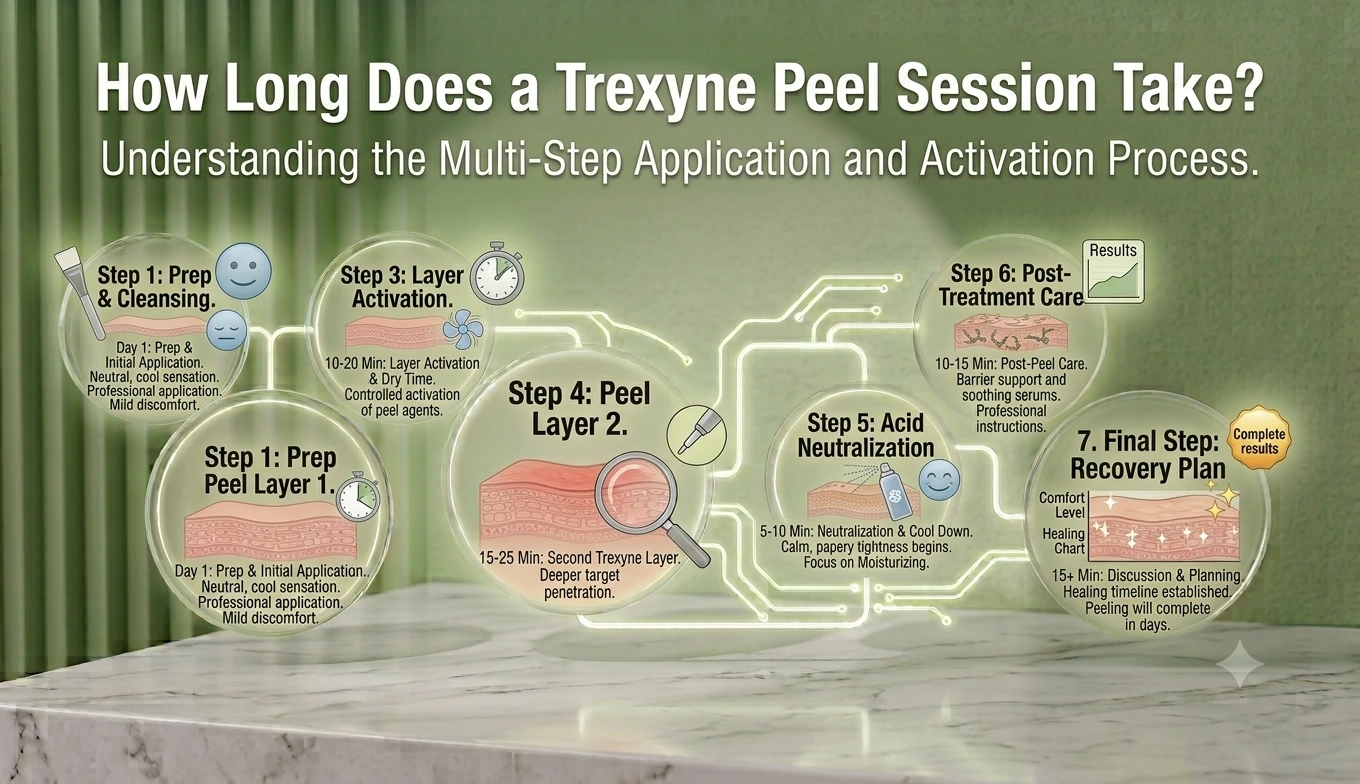
How Long Does a Trexyne Peel Session Take?
A Trexyne Peel session itself typically takes between 30 and 60 minutes, depending on the treatment area, the intensity level selected within the tiered protocol, and how much time the practitioner allocates to pre-treatment assessment and post-treatment care. For clients fitting the appointment into a working day or planning around other commitments, this makes the Trexyne Peel a genuinely practical professional treatment rather than one that demands half a day. That said, the session time is only one part of the overall appointment time. The consultation, skin assessment, preparation, and post-treatment guidance all add to the total time spent at the clinic, particularly for first appointments. The Trexyne Peel is designed around the principle of no extended downtime, and this practical, manageable approach to session length is part of what makes it suitable for clients with busy schedules who still want to invest in professional skin renewal.
Why Session Length Varies Between Appointments
No two Trexyne Peel sessions are exactly the same length, and understanding why helps clients and practitioners plan appointments more accurately. The variables that influence how long each session takes are straightforward and worth knowing in advance.
The treatment area is the most obvious factor. A full-face session takes longer than a session targeting a specific zone such as the cheeks alone. For clients addressing widespread photodamage, uneven tone across the full face, or concerns that span multiple areas, a full-face session will naturally take longer to complete than a session focused on a localised concern.
The intensity level selected within the tiered protocol also influences session time. More conservative sessions at lower intensities involve fewer passes over the skin and complete more quickly. Sessions at higher intensities, later in a treatment course when the skin has demonstrated good tolerance and the protocol has been progressed, may involve additional passes that extend the treatment time modestly.
The skin’s condition on the day of the appointment can also affect how long the preparation and assessment steps take. A client whose skin is presenting in a different condition from the previous session, whether due to recent sun exposure, a change in skincare routine, or a temporary reactive phase, may require a more extended assessment before the practitioner proceeds with treatment.
The First Appointment: Consultation and Treatment Combined
For clients attending a Trexyne Peel session for the first time, the appointment will be longer than subsequent sessions in the same course. This is because the first appointment includes not just the treatment itself but the comprehensive consultation that forms the clinical foundation of the entire course.
A thorough first consultation covers the skin’s current condition and history, any relevant medications and skincare products in use, the client’s specific concerns and goals, a realistic discussion of outcomes and timelines, and the pre and post-treatment guidance the client needs to manage their preparation and recovery correctly. This conversation takes time to do properly, and practitioners who rush through it to get to the treatment quickly are skipping the step that most directly determines whether the course will produce the right results for that individual.
Clients booking a first Trexyne Peel appointment should plan for a total appointment time of 60 to 90 minutes to accommodate the full consultation alongside the treatment and post-treatment care. This is longer than subsequent sessions in the course, where the assessment is shorter and the client already has the context and aftercare knowledge they need.
Follow-Up Sessions: How They Differ in Length
From the second session onwards in a treatment course, appointments are generally shorter than the first. The comprehensive consultation has already taken place, the client is familiar with the pre and post-treatment routine, and the practitioner’s assessment at subsequent sessions is a focused review rather than a full intake.
A follow-up session typically begins with a brief assessment of how the skin has responded to the previous session, a check of any changes to medications or skincare since the last appointment, and a discussion of how the client’s recovery went. This assessment informs the practitioner’s decision about whether to maintain or progress the treatment intensity for the current session.
The treatment itself then proceeds, followed by post-treatment care and any updated guidance for the upcoming recovery period. For most clients at moderate intensity, a follow-up session from start to finish takes around 45 to 60 minutes. At more conservative intensities, particularly for clients with sensitive skin or those in the early sessions of a course, total appointment time may be closer to 30 to 45 minutes.
Planning Session Spacing and Total Appointment Commitment
For clients planning a full treatment course, understanding both the session duration and the recommended spacing between sessions helps with longer-term diary planning. Sessions are typically spaced three to four weeks apart, aligning with the skin’s natural cell turnover cycle. A course of sessions over three to four months therefore involves a predictable, manageable commitment of one appointment per month rather than frequent, intensive scheduling.
This makes the Trexyne Peel course practical for clients managing busy professional or family lives alongside their treatment, which is one of the practical advantages of a treatment designed with realistic scheduling in mind.
What Happens During the Session: A Step-by-Step Overview
Understanding what takes place during a Trexyne Peel session helps clients know what to expect when they arrive and what each part of the appointment contributes to.
The session begins with the practitioner reviewing the skin’s current condition and confirming that it is appropriate to proceed. For clients who have been following pre-treatment guidance correctly, this assessment typically confirms that everything is in order and the session can proceed at the planned intensity.
The practitioner then cleanses the skin thoroughly, removing any product residue, excess sebum, and surface debris that could interfere with the treatment’s contact with the skin. This preparation step is not rushed. A well-cleansed skin surface ensures that the treatment can work as intended across the full treatment area without uneven contact.
The Trexyne Peel is then applied to the skin. The marine-algae spicules create controlled micro-channels through their physical contact with the skin surface, stimulating the renewal response that produces the treatment’s benefits. The practitioner applies the treatment methodically across the treatment area, managing technique and coverage to ensure consistent contact.
The treatment application itself typically takes 15 to 25 minutes for a full-face session, depending on the number of passes and the intensity selected. During this time, clients typically notice mild tingling or warmth, which is the skin’s normal response to the mechanical micro-channelling.
Once the treatment has been applied, the practitioner completes the session with any appropriate post-treatment care, confirms the aftercare guidance, and addresses any questions the client has about the recovery period ahead.
How the Trexyne Peel’s Design Supports a Practical Session Format
The Trexyne Peel is not simply a treatment that happens to be quick. Its design specifically supports a practical, manageable session format that fits into real schedules without demanding excessive clinic time or extended preparation.
The mechanical resurfacing mechanism means there is no chemical agent being applied, no reaction to monitor during the session, and no variable timing that depends on how a chemical process unfolds. The practitioner applies the treatment, manages the technique in real time, and completes the session when the planned coverage is complete. This directness contributes to a session format that is efficient without feeling rushed.
The Trexyne Peel‘s tiered protocol also allows the session length to be matched to the intensity being applied. Conservative sessions at lower intensities are shorter. More intensive sessions at higher tiers take modestly longer. This proportionality between session time and treatment depth means clients are not spending extended time in the clinic for treatments at conservative intensity, and practitioners can manage their appointment books efficiently across a range of client needs.
Fitting a Trexyne Peel Into a Busy Schedule
One of the most common practical questions clients ask before booking a professional resurfacing course is whether they can realistically fit it into their life. The answer for the Trexyne Peel is generally yes, for clients who are thoughtful about scheduling.
The 30 to 60 minute session time for follow-up appointments means the treatment can typically fit into a lunch break, an early morning before work, or a late afternoon slot without requiring a full half-day away from normal commitments. This is not the case for all professional resurfacing treatments, and for clients whose concern about professional peels is as much practical as clinical, this accessibility matters.
The recovery period following a session should also be factored into scheduling. While most clients can return to normal activities the same day, the first 48 hours involve some redness and tightness, and the shedding phase from around day three may make clients feel less comfortable attending formal events or high-stakes professional situations. Planning sessions with this recovery window in mind, ideally with a few days of lower-intensity commitments after each appointment, produces the most comfortable experience.
For clients with specific events in their diary, such as weddings, holidays, or significant work commitments, scheduling sessions with enough lead time for full recovery is simply good planning. The practitioner can help with this at the initial consultation, mapping out a course timeline that avoids conflicts between session recovery and important dates.
What Clients Do Before and After the Session
The session time itself is only one part of the overall time commitment a Trexyne Peel course involves. Understanding what clients need to do before and after each appointment gives a more complete picture of the total investment.
Before each session, clients follow a preparation protocol that involves pausing active skincare ingredients for the appropriate period, avoiding significant sun exposure, and keeping the routine simplified to cleanser, moisturiser, and SPF. This preparation does not require any clinic time, but it does require some planning and awareness in the days leading up to each appointment.
After each session, the recovery period involves following specific aftercare guidance: a simplified routine, daily SPF, heat avoidance for the first 48 hours, and allowing any shedding to resolve naturally. Again, this does not require additional clinic visits between sessions unless the client has a concern they want to discuss, which can often be addressed by telephone or message rather than an in-person appointment.
The Trexyne Peel is designed to be a professional treatment with a manageable footprint in a client’s daily life, both during sessions and in the recovery periods between them. This approach reflects the understanding that effective treatment needs to be sustainable for the client across the full course, not just clinically effective in isolation.
Practitioners interested in stocking the Trexyne Peel can explore the full product range via the Trexyne shop, or get in touch with the team directly through the Trexyne contact page.
How Session Length Relates to Results
It would be misleading to suggest that a longer session automatically produces better results. The relationship between session time and outcome is more nuanced than that, and understanding it helps clients evaluate what they are getting from each appointment.
A session at conservative intensity that takes 35 minutes may produce a more appropriate result for that individual’s skin at that stage of their course than a session at maximum intensity that takes 60 minutes would. The practitioner’s clinical judgement in selecting the right intensity for the skin’s current condition is what determines the outcome, not the session duration.
What does influence cumulative results significantly is consistency across sessions. A course of well-spaced, appropriately intensive sessions, each followed by proper aftercare and daily SPF use, produces the progressive improvement that professional resurfacing is designed to deliver. A shorter course with fewer, longer sessions at maximum intensity from the outset is generally less appropriate than a graduated course that builds carefully to the right level for each individual’s skin.
The Trexyne Peel’s tiered protocol is designed precisely to support this kind of gradual, well-managed progression. Session length reflects the intensity chosen for that session, and intensity reflects the skin’s demonstrated tolerance and the clinical judgement of the practitioner. Clients who trust this process and allow it to unfold at its appropriate pace consistently see the best results.
Questions to Ask at Your First Appointment
Clients who arrive at a first Trexyne Peel session prepared with relevant questions tend to leave with a clearer and more confident understanding of what their course will involve. The following questions are worth raising at or before the initial consultation.
How long will each session in my course take? A practitioner who has assessed the individual’s skin and planned the course can give a realistic estimate rather than a generic range.
What should I do if I cannot attend a scheduled session? Understanding the clinic’s approach to rescheduling and how it affects course timing helps with longer-term planning.
Will the session length change as the course progresses? Knowing that early, conservative sessions may be shorter than later, more intensive ones helps set expectations for the full course.
Is there anything about my schedule or lifestyle that I should mention? A practitioner who understands a client’s upcoming commitments, travel plans, or relevant life events can help structure the course timing to avoid conflicts.
More information on the Trexyne approach to professional botanical resurfacing is available on the Trexyne website.
Conclusion
A Trexyne Peel session typically takes between 30 and 60 minutes for follow-up appointments, with first consultations and treatment combined taking 60 to 90 minutes. The exact duration depends on the treatment area, the intensity level selected within the tiered protocol, and the individual’s skin condition at the time of each appointment. The mechanical resurfacing mechanism and the structured tiered protocol contribute to a session format that is efficient, consistent, and manageable for practitioners and clients alike. Recovery begins within hours of each session and follows a predictable timeline, with most clients settled within a week after moderate-intensity sessions. The Trexyne Peel is designed to fit into real lives without excessive disruption, and the practical session format is an integral part of what makes a sustained treatment course achievable. With consistent sessions, appropriate spacing, and good aftercare, it may support a brighter, more even-looking complexion that builds progressively across a manageable and well-planned professional treatment programme.
FAQs
Q: How long does a Trexyne Peel session take?
A follow-up Trexyne Peel session typically takes between 30 and 60 minutes from start to finish, depending on the treatment area and the intensity selected. A first appointment, which includes a full consultation alongside the treatment, takes 60 to 90 minutes. Session length varies modestly based on the individual’s skin condition and the stage of the treatment course.
Q: Can I fit a Trexyne Peel into my lunch break?
For most follow-up sessions at moderate intensity, yes. A 30 to 60 minute session fits within a typical lunch break for many clients. It is worth allowing a little extra time for the journey and for any post-treatment discussion with the practitioner. The first appointment will need a longer slot due to the full consultation.
Q: How often do I need to come in for Trexyne Peel sessions?
Sessions are typically spaced three to four weeks apart, aligning with the skin’s natural cell turnover cycle. A standard treatment course of multiple sessions therefore involves approximately one appointment per month. This spacing is part of how the treatment supports cumulative, progressive results without over-treating the skin.
Q: How long does the Trexyne Peel treatment part of the session take?
The treatment application itself typically takes 15 to 25 minutes for a full-face session. The remainder of the appointment time includes assessment, preparation, and post-treatment care. Total appointment time from arrival to departure is generally 30 to 60 minutes for follow-up sessions.
Q: Do I need to take time off work after a Trexyne Peel session?
Most clients do not need to take time off work after a Trexyne Peel session. Normal activities can be resumed from the day after treatment for most people. The first 48 hours may involve some redness and tightness, and clients in client-facing roles or with high-visibility commitments may prefer to schedule sessions with a day or two of lower-intensity work afterwards.
Q: Will my Trexyne Peel sessions get longer as the course progresses?
Not significantly. Session duration changes modestly as intensity is progressed through the tiered protocol, with higher-intensity sessions involving slightly more treatment time than very conservative early sessions. The variation is not dramatic, and the practitioner can give a realistic estimate for each stage of the course based on the planned intensity progression.
Q: Where can I find a practitioner offering the Trexyne Peel?
The Trexyne Peel is available exclusively through verified practitioners and clinics. Clients can enquire through the Trexyne contact page to find out about practitioners offering the treatment. Practitioners interested in stocking and offering the Trexyne Peel can find product information and supply options through the Trexyne shop.