How to Prepare Your Skin Before a Professional Peel
Good preparation before a professional peel makes a meaningful difference to how the treatment goes and how well the skin recovers. It is not complicated, but it does require some deliberate steps in the days and weeks leading up to the appointment. The goal of pre-treatment preparation is to arrive at the session with skin that is at its settled baseline: not sensitised by recent active ingredients, not compromised by recent procedures or sun exposure, and in a stable enough condition for the practitioner to assess accurately and treat confidently. For clients booking a session of the Trexyne Peel, the same principles apply as for any professional resurfacing treatment. A practitioner will provide specific written guidance tailored to the individual, but understanding the reasons behind each preparation step helps clients follow through with it consistently rather than treating it as optional housekeeping before an appointment.
Book a Consultation Before Your First Session
The first and most important step in preparing for a professional peel is attending a thorough consultation before any treatment is booked. A consultation is not simply a formality. It is the clinical foundation of the entire treatment plan.
During a proper consultation, the practitioner will assess the skin’s current condition, ask about skin history and previous treatments, review any current medications and skincare products, discuss the client’s specific concerns and goals, and explain the proposed treatment approach including the expected recovery and realistic outcomes.
For the client, this is the opportunity to ask questions, disclose relevant information, and build a clear picture of what the treatment involves. Clients who attend a consultation properly are more likely to manage their preparation and aftercare correctly, because they understand the reasoning behind the guidance they have been given rather than simply following instructions without context.
If a practitioner does not offer a proper consultation before treatment or moves straight to booking without a skin assessment, this is a signal to ask more questions before proceeding.
Start Protecting Your Skin With Daily SPF Now
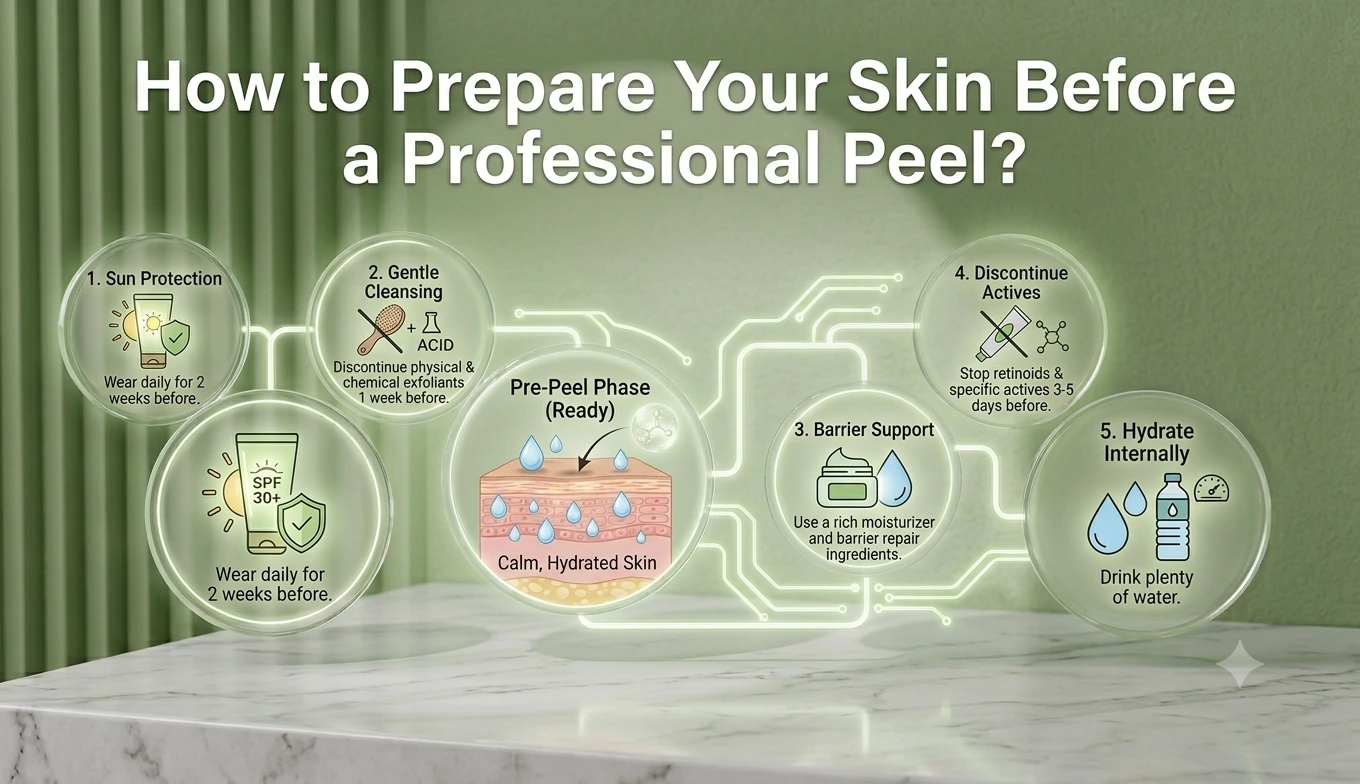
If daily broad-spectrum SPF is not already part of the skincare routine, starting it as early as possible before a professional peel is one of the most impactful preparation steps. UV exposure in the weeks before treatment can increase the skin’s inflammatory baseline, worsen any existing pigmentation, and produce a less settled skin condition at the time of the session.
For clients with pigmentation concerns, UV exposure in the period leading up to a resurfacing course can also actively deepen existing marks, meaning the treatment starts from a more established starting point than it would if photoprotection had been in place for several weeks or months before the first session.
Daily SPF applied every morning, including on overcast days and during short outdoor journeys, creates the most favourable skin condition for treatment. This habit also needs to be maintained throughout the treatment course and beyond, which makes starting it before the first session useful as a habit to establish rather than a temporary instruction.
Simplify Your Skincare Routine in the Week Before
In the seven to ten days before a professional resurfacing session, the routine should be stripped back to its essentials. Active ingredients that increase skin sensitivity need to be paused to allow the skin to return to its settled baseline before treatment.
The ingredients to pause include retinoids (retinol, retinaldehyde, tretinoin, and other prescription vitamin A derivatives), home-use exfoliating acids including AHAs, BHAs, and PHAs, high-concentration vitamin C serums, benzoyl peroxide, and enzyme exfoliants. Each of these either thins the stratum corneum, increases skin sensitivity, or introduces an active exfoliating stimulus that can compound the effect of professional resurfacing in ways that produce a more difficult recovery than expected.
The simplified routine during this preparation window should consist of a gentle, fragrance-free cleanser, a simple fragrance-free moisturiser, and daily broad-spectrum SPF. Gentle, non-active ingredients including niacinamide, hyaluronic acid, and peptide-based products can generally be continued without concern.
The specific pause timelines for each active ingredient vary. Retinoids require the longest pause of five to ten days depending on strength. Prescription-strength retinoids should be paused for at least seven to ten days. Home-use exfoliating acids should stop five to seven days before the session. High-concentration vitamin C and benzoyl peroxide require two to five days. The practitioner’s written guidance takes precedence over any general recommendation.
Avoid Waxing, Threading, and Hair Removal Procedures
Hair removal procedures that involve contact with the skin surface should be avoided in the week before a professional resurfacing session. Waxing, threading, and epilation create micro-trauma at the skin surface and leave the treated area more reactive and sensitive than usual. Applying professional resurfacing to skin that has recently had any of these procedures increases the risk of irritation and uneven results.
If waxing or threading is part of a regular routine, scheduling it at least seven to ten days before a resurfacing session, rather than in the days immediately before, allows the skin to settle fully before treatment.
Laser or IPL hair removal should be avoided for a longer period around any professional resurfacing session, and the specific gap required between the two procedures should be discussed with the practitioners involved in both treatments.
Avoid Significant Sun Exposure in the Two Weeks Before
Significant sun exposure in the two weeks before a professional peel can increase the inflammatory baseline of the skin and, in susceptible skin types, worsen existing pigmentation in ways that affect both what the practitioner observes at assessment and how the skin responds to treatment.
A suntan acquired shortly before a resurfacing session is a clinical indicator that the skin’s melanocytes are currently activated and the skin is in a more reactive state than its normal baseline. Most practitioners will defer treatment or significantly reduce intensity for skin presenting with recent visible sun exposure.
A recent sunburn is a clear contraindication for proceeding with any resurfacing treatment. Sunburned skin is already inflamed, compromised, and acutely reactive. Treatment should be deferred until the skin has fully recovered and returned to a settled baseline, typically at least two to three weeks after the burn has resolved.
Applying and reapplying daily SPF consistently during the two weeks before a session provides the most reliable protection against this preparation risk.
Be Honest About Your Skincare Routine at Every Assessment
Pre-treatment assessment works best when the practitioner has an accurate picture of the skin’s current state, including any recent product use that might influence sensitivity. Clients who do not think to mention their retinol use, who forget to disclose a recent enzyme mask, or who assume the practitioner does not need to know about their prescription acne topical, are inadvertently preventing the practitioner from selecting the most appropriate treatment intensity.
Disclosing the full skincare routine at every assessment, not just the first consultation, ensures that intensity is calibrated accurately to the skin as it actually presents rather than as the practitioner assumes it to be. This is one of the most practical steps a client can take to protect their own outcome across a sustained treatment course.
If a client has forgotten to pause an ingredient for the full recommended period before an appointment, telling the practitioner at the start of the session is more useful than not mentioning it. The practitioner can adjust intensity accordingly or advise a brief delay rather than proceeding with an unknowingly sensitised skin.
Manage Your Expectations Honestly Before You Start
Preparation is not only practical. It also involves arriving at a first session with a realistic understanding of what the treatment course will involve and what outcomes are achievable in what timeframe.
Professional resurfacing courses produce improvement that builds progressively across sessions rather than appearing dramatically after one appointment. Recovery periods are real and need to be factored into planning around work, social commitments, and events. Some clients experience temporary purging of congestion in the early sessions, which is a normal part of the renewal process rather than a sign that the treatment is not working.
Clients who arrive at the first session with these realities already understood are significantly more likely to complete the full course, follow aftercare consistently, and evaluate their results accurately. Those who arrive expecting a dramatic overnight transformation and are not prepared for a progressive, managed process are more likely to abandon a course at the moment when it is just beginning to produce meaningful progress.
Practitioners offering the Trexyne Peel can explore the full product range and stocking options through the Trexyne shop, and can direct any clinical questions to the team through the Trexyne contact page.
The Day Before Your Session
The day immediately before a professional resurfacing session is not the time to make changes or additions to the routine. Whatever simplified, active-free routine has been followed through the preparation window should simply be continued.
Specifically, clients should avoid trying any new products on the day before or the day of the session. An unfamiliar product that causes a reaction in the 24 hours before treatment could result in the session being deferred or modified unexpectedly. Sticking to familiar, well-tolerated products removes this variable.
Keeping the skin clean and well-moisturised on the day of the session, avoiding vigorous exercise immediately before the appointment, and arriving without heavy makeup where possible all contribute to a straightforward and comfortable session.
It is also worth ensuring the practitioner has all relevant information before the session begins, including any changes to medications or skincare since the last appointment, any illnesses, and any concerns about the upcoming session. A practitioner who is fully informed can provide the best possible clinical care.
Conclusion
Preparing well for a professional peel is a straightforward process that requires consistency rather than complexity. Starting daily SPF early, simplifying the routine in the week before treatment by pausing active ingredients, avoiding hair removal and significant sun exposure in the preceding days, and arriving at the consultation with a full and honest account of current skincare and medication use all contribute to a session that the practitioner can deliver confidently and that the skin can recover from smoothly. The Trexyne Peel is administered by trained practitioners who use a tiered protocol to match intensity to the individual’s skin condition on the day, which means the quality of preparation directly influences the quality of the outcome. With the right groundwork in place, each session is positioned to deliver the best possible contribution to a brighter, more even-looking complexion over the course of the treatment programme.
More information on the Trexyne approach to professional botanical resurfacing is available on the Trexyne website.
FAQs
Q: How should I prepare my skin before a professional peel?
Start daily broad-spectrum SPF as early as possible before your first session. In the seven to ten days before each appointment, pause active skincare ingredients including retinoids, home-use exfoliating acids, high-concentration vitamin C, and benzoyl peroxide. Keep the routine simple: cleanser, moisturiser, and SPF. Avoid waxing, threading, and significant sun exposure in the week before. Disclose your full skincare routine at every assessment.
Q: How many days before a peel should I stop using active skincare?
Retinoids require five to ten days depending on strength, with prescription retinoids at the longer end. Home-use exfoliating acids require five to seven days. High-concentration vitamin C and benzoyl peroxide require two to five days. The practitioner’s specific written guidance takes precedence over general recommendations and reflects the individual’s skin condition and the treatment intensity planned.
Q: Can I get a tan before a professional peel?
No. Recent significant sun exposure or a visible tan indicates that melanocytes are currently activated and the skin is in a more reactive state than its normal baseline. Most practitioners will defer treatment or reduce intensity for skin presenting with recent visible sun exposure. Sunburn in the weeks before an appointment is a clear contraindication for proceeding.
Q: What should I eat or drink before a professional peel?
There are no specific dietary requirements before a professional resurfacing session. Staying well hydrated and avoiding alcohol in the 24 hours before the appointment supports general skin health and wellbeing without any clinical necessity beyond that. The practical preparation steps around skincare routine and sun protection are far more clinically significant than dietary factors.
Q: Should I attend a consultation before my first professional peel?
Yes, without exception. A consultation before a first resurfacing session is the clinical foundation of the treatment plan. It allows the practitioner to assess the skin, review history and current medications, discuss goals and realistic outcomes, and provide specific pre-treatment guidance. Proceeding without a proper consultation increases the risk of a treatment that is not well matched to the individual’s skin.
Q: What happens if I forget to stop my retinol before a peel?
Tell your practitioner at the start of the session. A practitioner who knows the skin is retinol-sensitised can adjust the planned intensity accordingly or advise a brief delay of a few days to allow the pause to be completed. Proceeding without disclosure risks a more intense response and longer recovery than the selected treatment intensity would normally produce.
Q: Can I wear makeup to my professional peel appointment?
Arriving without heavy makeup, or with minimal makeup that can be easily removed before treatment, is preferable to arriving with a full face of product. The practitioner will cleanse the skin before the session begins, but minimising product on the skin makes this process straightforward. Avoiding new or unfamiliar makeup products in the 24 hours before the session removes the risk of an unexpected reaction close to the appointment.