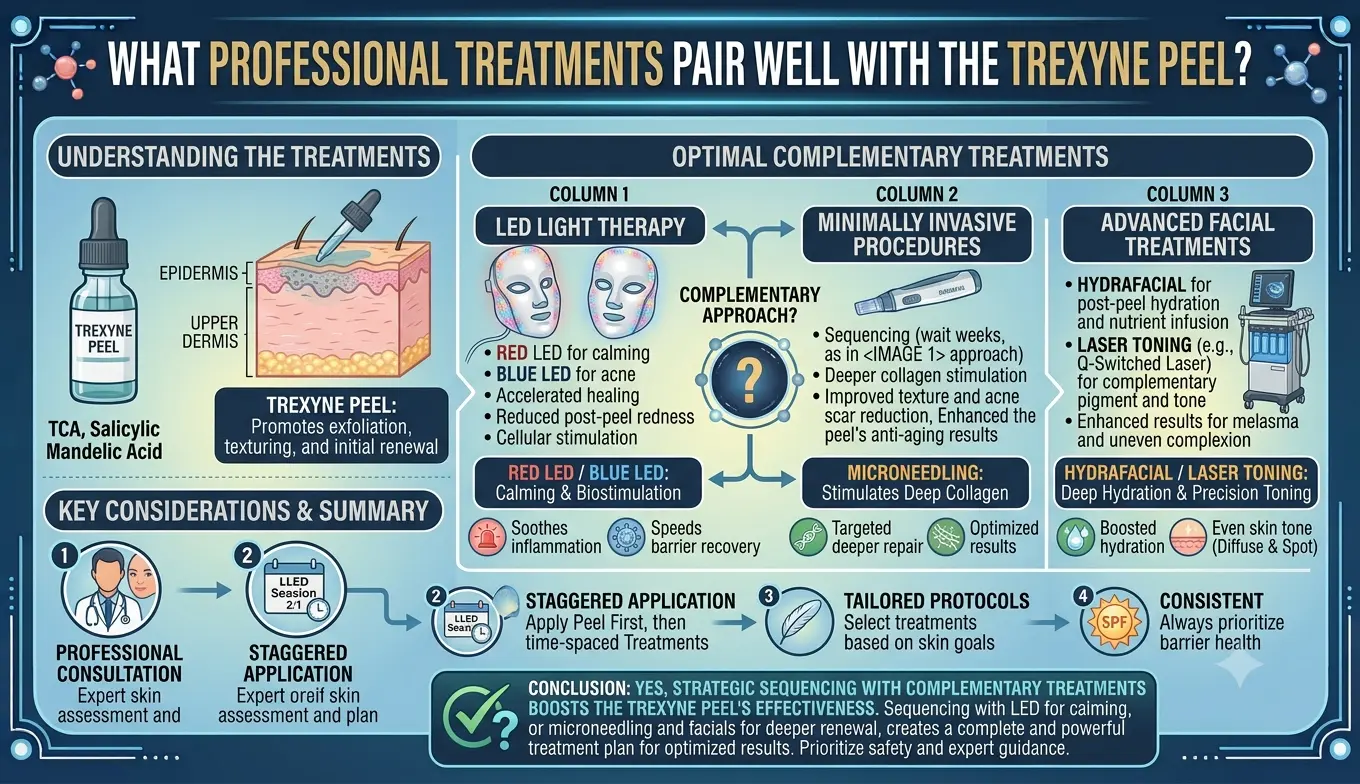
What Professional Treatments Pair Well With the Trexyne Peel?
Treatments that support skin hydration, calm inflammation, and protect the skin barrier tend to pair well with the Trexyne Peel, particularly when they are scheduled with proper spacing around the resurfacing session itself. Because the Trexyne Peel works through a mechanical mechanism, using marine-algae spicules rather than chemical exfoliants, it fits naturally into a wider clinic protocol built around gentle, complementary support rather than layering multiple aggressive treatments in a short space of time. Building a combination protocol is not just about stacking treatments together. It is about sequencing them sensibly, so the skin has the best possible chance to respond well to each one. The Trexyne Peel can sit comfortably at the centre of this kind of plan, provided the surrounding treatments and their timing are chosen with care.
Why Combination Protocols Are Worth Considering
Addressing more than one concern at once
Clients rarely come to clinic with a single, isolated concern. Someone booking in for resurfacing may also want support with hydration, dullness, or general skin condition. A thoughtfully built protocol, with the Trexyne Peel as the resurfacing foundation, allows a practitioner to address several of these concerns across a course rather than trying to solve everything within one treatment type.
Clinics that offer a broader treatment menu are often well placed to build these kinds of protocols, since they can draw on a range of complementary options rather than relying on the Trexyne Peel alone to do every job. This does not mean every client needs a combination plan. Some clients are perfectly well served by a standalone course. It simply means the option exists for those who would benefit from a more rounded approach.
Supporting the skin’s overall response
Pairing the right treatments together, in the right order, can help the skin feel more comfortable throughout a course and may support how well it responds to resurfacing over time. This is less about adding more treatments for the sake of it and more about choosing additions that genuinely complement the mechanical, spicule-based approach the Trexyne Peel is built around.
Client retention and long-term relationships
There is also a practical business benefit to thinking in terms of combination protocols. Clients who are offered a well-considered, personalised plan, rather than a single isolated treatment, often feel more engaged with their overall skincare journey. This tends to support longer-term relationships between client and clinic, built around ongoing care rather than a single transaction.
Hydration-Focused Treatments
Why hydration support matters around resurfacing
Skin that is well hydrated tends to look and feel more comfortable in the days following a resurfacing session. A hydration-focused treatment, scheduled either before a Trexyne Peel session or during the recovery window between sessions, can help support the skin’s general condition without interfering with the mechanical renewal process the peel is designed to encourage.
Clients with naturally drier skin, or those going through a season where their skin tends to feel more dehydrated, such as the colder winter months, may notice particular benefit from this kind of pairing. It is worth asking about seasonal changes in skin condition at consultation, since this can help inform which complementary treatments are worth suggesting.
Timing hydration treatments around a course
Rather than combining treatments within the same appointment, many practitioners find it more comfortable for the client to schedule a hydration-focused treatment in the gap between Trexyne Peel sessions. This gives the skin a chance to settle from the resurfacing step first, before introducing an additional treatment on top.
This approach also makes it easier to track which treatment is responsible for which change. If a hydration treatment and a resurfacing session happen too close together, it becomes harder to judge how the skin is genuinely responding to each one individually, which can complicate decisions about adjusting the protocol going forward.
LED Light Therapy
A gentle, non-invasive addition
LED light therapy is a non-invasive treatment that many clinics already offer as part of their general facial menu. Because it does not involve any mechanical or chemical exfoliation itself, it is often considered a gentle addition that can sit alongside a resurfacing protocol without adding further physical stress to the skin.
Where LED fits in the schedule
Some practitioners choose to offer LED sessions during the interval between Trexyne Peel appointments, as a way of supporting the skin’s general comfort and condition without disrupting the renewal cycle the peel has already set in motion. As with any combination approach, the right spacing should always be based on how the individual client’s skin is responding.
Because LED sessions tend to be relatively short and do not typically require any recovery time of their own, they can be a convenient option to slot into a client’s existing appointment pattern without adding significant extra time to their overall course. This makes it a popular starting point for practitioners who are new to building combination protocols.
Facial Massage and Manual Techniques
Supporting circulation and general skin condition
Facial massage, performed as part of a standard facial treatment, can support circulation and general skin condition. When used thoughtfully around a resurfacing course, this kind of gentle manual technique may complement the overall protocol, provided the skin is not still in an early, more sensitive stage of recovery from a recent Trexyne Peel session.
Avoiding overworking freshly treated skin
Immediately after a Trexyne Peel session, the skin is in its recovery phase, supported from the first application by the stabilised Vitamin E infused into the treatment. Introducing vigorous manual techniques too soon after a session is generally best avoided, with facial massage more appropriately scheduled later in the interval between appointments, once the skin has settled.
A useful rule of thumb, though always subject to individual assessment, is to reserve any firmer manual work for the later part of the gap between sessions, once the practitioner has confirmed the skin has settled comfortably from the previous appointment. Lighter, more gentle techniques may be appropriate earlier in the recovery window, depending on how the client’s skin has responded historically.
Skin Barrier Support Treatments
Why barrier support complements resurfacing
A healthy skin barrier plays an important role in how comfortably skin moves through any resurfacing course. Treatments and products focused specifically on supporting the skin barrier, such as barrier-repair facials built around soothing, non-active ingredients, can be a sensible addition for clients whose skin needs a little extra support alongside their Trexyne Peel sessions.
Choosing the right moment for barrier support
Barrier-focused treatments tend to work well when scheduled either shortly before a course begins, to prepare the skin, or during the interval between sessions, to help maintain comfort throughout. Introducing this kind of support early in the relationship with a new client can also give the practitioner useful information about how that client’s skin generally behaves before the resurfacing course gets underway.
Building a Sensible Treatment Sequence
Resurfacing first, softer treatments after
A common and sensible approach is to treat the Trexyne Peel session as the anchor point of the protocol, with gentler, complementary treatments scheduled around it rather than layered directly on top of it. This respects the mechanical renewal process the peel supports and gives each treatment a proper chance to do its own work without competing for the skin’s attention at the same time.
Reviewing the full protocol at consultation
Before combining any treatments, it is worth reviewing the client’s full treatment history and current skin condition. A practitioner who understands what else the client is having done, whether in your own clinic or elsewhere, is far better placed to build a sequence that genuinely supports the skin rather than overloading it.
Documenting the sequence for consistency
Once a sequence has been agreed, keeping a written record of what has been done, and when, helps maintain consistency if the client sees more than one practitioner within the same clinic. This also makes it far easier to review the plan at each visit and adjust the sequence if the skin’s response calls for a change.
Treatments to Approach With Extra Caution
Other exfoliating or resurfacing treatments
Because the Trexyne Peel already works to resurface the skin through its mechanical mechanism, combining it closely in time with other resurfacing or exfoliating treatments needs careful thought. Stacking multiple resurfacing modalities too close together can increase the overall physical demand placed on the skin, which is why spacing and sequencing matter just as much here as with any gentler addition.
Treatments involving heat or intense stimulation
Treatments that generate significant heat or intense stimulation are generally best kept at a sensible distance from a Trexyne Peel session, allowing the skin’s recovery phase to complete before introducing something more intensive. A practitioner familiar with both treatments is best placed to judge an appropriate gap based on how the client’s skin has responded previously.
Making the call as a practitioner
Ultimately, decisions about combining treatments should always be made on a case-by-case basis, taking into account the client’s skin type, treatment history, and how they have responded to previous sessions. There is no single combination that suits every client, which is exactly why professional judgement, rather than a fixed formula, should guide these decisions.
When in doubt, it is always reasonable to err on the side of caution and allow more time between more intensive treatments rather than less. A slightly longer, more conservative protocol is far easier to adjust and speed up later than one that has caused unnecessary irritation by moving too quickly at the outset.
Building a Client-Specific Combination Plan
Starting with the primary goal
Every combination plan should start with a clear understanding of what the client is ultimately trying to achieve. If resurfacing and a more even-looking complexion are the main priority, the Trexyne Peel should remain the central focus of the protocol, with any additional treatments chosen specifically to support that goal rather than distract from it.
Reviewing progress across the whole protocol
Just as with a standalone Trexyne Peel course, it is worth reviewing progress across the full combination protocol at regular intervals. Photographs and short consultations at each visit help confirm that the additional treatments are genuinely complementing the resurfacing work, rather than simply adding time and cost without a clear benefit.
This kind of regular review also gives the client an opportunity to raise any concerns about how the combination is feeling, whether that is comfort during recovery, the overall time commitment, or the cost of running several treatments alongside one another. Addressing these points as they come up tends to keep clients more satisfied with the plan overall.
Adjusting the plan as needed
A combination protocol should never be treated as fixed from the outset. If a client’s skin responds particularly well to one element of the plan, or struggles with another, the practitioner should feel free to adjust the balance of treatments accordingly. Flexibility, guided by how the skin is actually responding, tends to produce the most satisfying outcomes.
Professional Consultation Before Combining Treatments
Why a full history matters
Before recommending any combination protocol, a thorough consultation should cover the client’s full treatment history, including anything they may be having done outside your own clinic. Clients do not always think to mention treatments from other providers unless specifically asked, so it is worth making this a standard part of every consultation.
Setting out the plan clearly
Once a combination protocol has been agreed, writing it out clearly for the client, including approximate timings between each treatment type, helps avoid confusion later on. This also gives the client something to refer back to if they are considering booking anything additional elsewhere during their course.
Common Questions Practitioners Ask About Combination Protocols
How many additional treatments is too many
There is no fixed limit on how many complementary treatments can sit alongside a Trexyne Peel course, but more is not automatically better. Each addition should have a clear purpose within the overall plan. If a treatment cannot be tied to a specific benefit for that particular client, it may be worth leaving it out rather than adding complexity without a clear reason.
Whether every client needs a combination plan
Not every client needs, or wants, a combination protocol. Some prefer a simpler course built entirely around the Trexyne Peel, and that is a perfectly valid choice. The decision should always be guided by the client’s goals, budget, and how much time they are able to commit to their overall skincare plan.
Supporting the Protocol With Simple Aftercare
Regardless of which treatments are included in a combination plan, consistent daily SPF use, a gentle skincare routine, and sensible sun avoidance all play a supporting role between appointments. These simple habits help protect the results of every treatment within the protocol, not just the Trexyne Peel sessions themselves, and they are worth reinforcing with clients at every visit.
Clinics interested in stocking the Trexyne Peel as part of a wider treatment menu can find pricing and pack details via the shop, and practitioners with specific questions about building a combination protocol are welcome to get in touch through the contact page. Further information about the brand is available on the Trexyne homepage.
Conclusion
Pairing professional treatments with the Trexyne Peel can support a more complete, client-specific protocol, provided the additions are chosen thoughtfully and sequenced with proper spacing. Gentle, complementary options such as hydration-focused treatments, LED light therapy, and facial massage tend to sit comfortably alongside a resurfacing course, while other resurfacing or intensive treatments need more careful timing to avoid overloading the skin. The Trexyne Peel’s mechanical, tiered approach, built around marine-algae spicules and stabilised Vitamin E, works well as the central anchor of a wider plan. With sensible sequencing and regular review, this kind of combination protocol can support a brighter, more even-looking complexion over the course of treatment.
FAQs
Q: Can the Trexyne Peel be combined with other facial treatments in the same appointment?
Many practitioners prefer to schedule complementary treatments around a Trexyne Peel session rather than within the same appointment, giving the skin a chance to begin its recovery phase before introducing anything additional.
Q: Is LED light therapy safe to have alongside a Trexyne Peel course?
LED light therapy is a gentle, non-invasive treatment that many practitioners include in the interval between Trexyne Peel sessions, though the right timing should always be based on how the individual client’s skin is responding.
Q: How long should I wait before having a facial massage after a Trexyne Peel session?
It is generally best to allow the skin’s initial recovery phase to settle before introducing more vigorous manual techniques, with facial massage more suitably scheduled later in the gap between sessions.
Q: Can I have a chemical peel from another provider alongside my Trexyne Peel course?
Combining different resurfacing or exfoliating treatments needs careful thought and proper spacing, as stacking multiple treatments too close together can increase the overall demand placed on the skin. This should always be discussed directly with your practitioner.
Q: Does hydration therapy help support results from the Trexyne Peel?
Hydration-focused treatments can support the skin’s general comfort and condition around a resurfacing course, and many practitioners schedule them during the interval between Trexyne Peel sessions.
Q: Who decides which treatments should be combined with my Trexyne Peel course?
A trained practitioner should assess your skin type, treatment history, and goals before recommending any combination protocol, since the right approach varies from client to client.
Q: Where can I find a clinic that offers combination protocols with the Trexyne Peel?
The Trexyne Peel is sold exclusively to verified practitioners and clinics. You can browse the shop or reach out through the contact page for guidance on finding a suitable clinic.