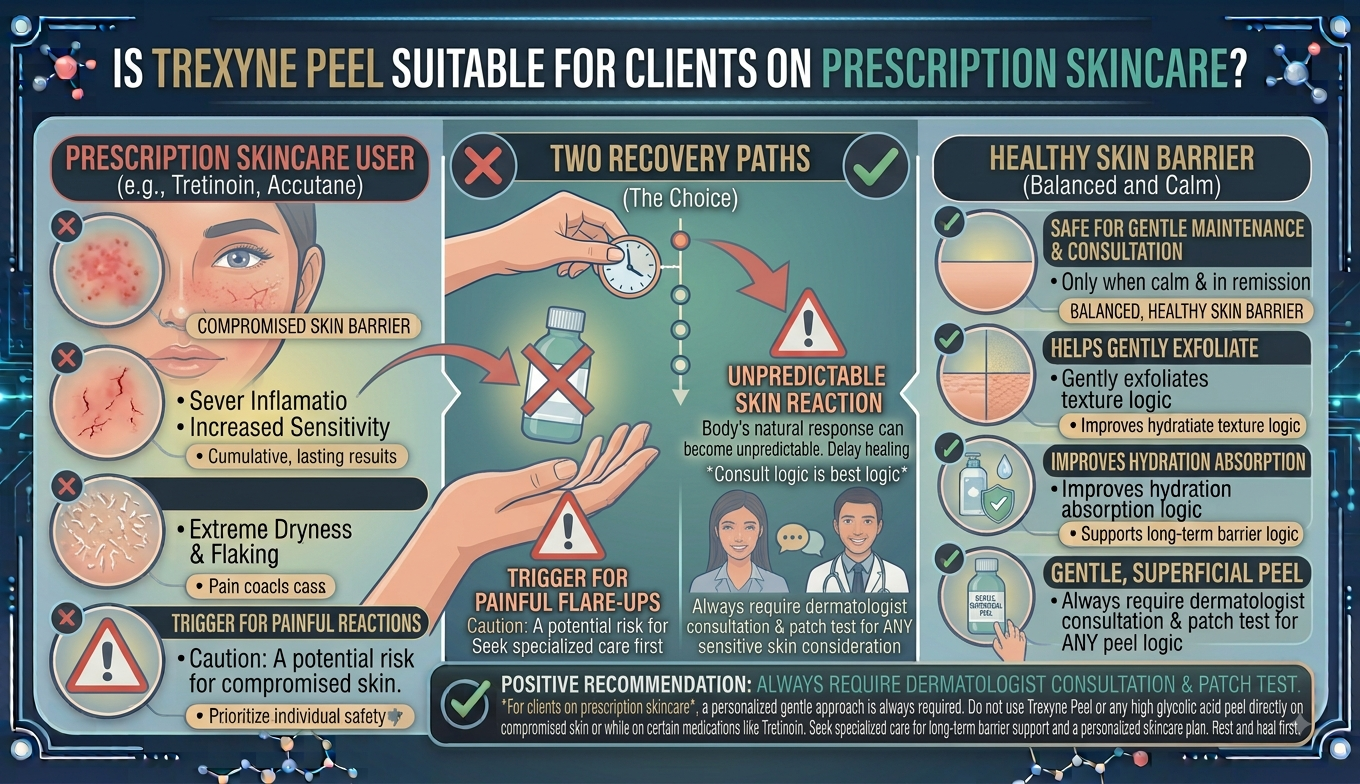
Is Trexyne Peel Suitable for Clients on Prescription Skincare ?
Yes, Trexyne Peel can be suitable for clients on prescription skincare, provided their barrier function is completely stable and their practitioner manages the treatment schedule with extreme care. Prescription topical regimes often increase epidermal fragility and cause temporary barrier instability, requiring thorough professional assessment before introducing resurfacing procedures. Incorporating the Trexyne Peel Professional Algae Resurfacing Treatment
allows trained aesthetic professionals to clear accumulated dead surface cells and refine texture through a purely mechanical mechanism. Driven by microscopic marine spicules and enriched with stabilised Vitamin E, this botanical treatment forms controlled micro-channels without chemical exfoliants. This physical approach enables practitioners to support skin renewal and encourage a brighter, more even-looking complexion with predictable downtime once prescription-induced sensitivity has subsided.
Understanding the Effects of Prescription Skincare on Epidermal Biology
Prescription dermatological topicals alter cellular dynamics and surface tissue behavior significantly. Aesthetic practitioners must understand these physiological changes to evaluate treatment suitability accurately.
Barrier Alterations and Trans-Epidermal Water Loss
Many prescription topicals accelerate epidermal cell turnover or thin the stratum corneum to manage specific cutaneous concerns. While highly effective, this process frequently weakens the intercellular lipid matrix and impairs the natural moisture barrier. Skin undergoing active prescription treatment often exhibits increased trans-epidermal water loss, micro-flaking, and heightened reactivity to environmental factors.
Increased Tissue Vulnerability and Sensitivity
Because prescription topicals alter normal keratinization, the underlying tissue becomes far more susceptible to mechanical friction and external stimulation. Applying professional resurfacing treatments to compromised or hypersensitive skin can trigger excessive erythema, prolonged discomfort, or barrier disruption. Practitioners must verify that the client has achieved complete surface stability before introducing any professional exfoliation procedure.
The Mechanical Action of Marine Algae Spicules in Professional Resurfacing
When working with clients who utilize specialized skincare regimes, selecting a resurfacing modality that works strictly through physical mechanisms is essential.
Precision Micro-Channeling Without Chemical Stress
Trexyne Peel relies entirely on micronized, needle-like spicules naturally harvested from marine algae. During clinical application, the practitioner gently massages these botanical spicules into the stratum corneum. The spicules create thousands of precise, physical micro-channels within the upper skin layers. This mechanical interaction dislodges dull, stagnant surface cells without altering skin pH or inducing chemical stress in delicate tissue.
Driving Natural Cellular Turnover and Desquamation
Once embedded within the upper epidermis, marine spicules stimulate the skin to initiate a controlled self-repair response. Lower epidermal layers divide faster, pushing older surface cells and spicules outward. This mechanical desquamation unfolds predictably over three to six days, allowing practitioners to encourage smooth, uniform shedding without relying on chemical penetration or aggressive surface abrasion.
The Barrier-Nourishing Role of Stabilised Vitamin E
Clients who have used active prescription formulas require immediate conditioning and lipid support during any professional resurfacing session.
Antioxidant Support for Fragile Stratum Corneum
The Trexyne Peel formulation incorporates stabilised Vitamin E, also known as tocopherol, directly within its spicule carrier matrix. Tocopherol is a lipid-compatible antioxidant that integrates seamlessly into the intercellular lipid layers during massage. As the spicules engage the tissue, stabilised Vitamin E delivers instant lipid conditioning, soothing the skin surface from the very first contact.
Maintaining Hydration During the Shedding Window
Reinforcing the lipid matrix helps lock in vital surface hydration and lowers trans-epidermal water loss throughout the recovery phase. Stabilised Vitamin E helps reduce post-treatment redness and keeps newly revealed tissue flexible, soft, and comfortable while old surface layers shed naturally. Practitioners looking to source professional botanical supplies can explore our full range on the official Trexyne shop page
.
Protocol Protocols: Managing the Washout Window Before Treatment
Safety is paramount when combining professional clinical procedures with active topical prescriptions. Establishing an appropriate pause window prevents unwanted sensitivity.
Implementing a Strict Washout Period
To ensure optimal barrier integrity, practitioners must instruct clients to temporarily pause their prescription topicals prior to receiving a Trexyne Peel. Depending on the specific prescription strength and individual barrier resilience, this washout period typically ranges from seven to fourteen days. Halting active topicals allows the stratum corneum time to rebuild its protective lipid layers and stabilize surface nerve endings.
Assessing Barrier Readiness Before Application
During the pre-treatment consultation, the practitioner must examine the skin under magnification to confirm that all signs of prescription-induced dryness, peeling, or irritation have completely resolved. Treatment must only proceed when the skin barrier appears intact, calm, and well-hydrated. If any lingering redness or flaking is observed, the resurfacing appointment should be rescheduled.
Customising Protocol Tiers for Client Safety
Trexyne Peel features a flexible, tiered protocol system that empowers trained professionals to control treatment intensity based on individual skin history.
Selecting Level 1 Protocols for Recovering Skin
For clients who have recently completed a prescription washout period, practitioners should always select a Level 1 protocol. This gentle entry tier utilizes light physical massage pressure and shorter contact duration. It allows the practitioner to introduce marine spicules smoothly, refining texture and boosting radiance while maintaining maximum barrier comfort.
Avoiding High-Intensity Protocols on Fragile Skin
While higher protocol tiers provide deeper physical exfoliation for thick or weathered complexions, they are unsuitable for skin with a history of prescription-induced sensitivity. Applying excessive pressure or extended massage can over-stimulate fragile surface capillaries and compromise a recovering barrier. Keeping application light ensures effective, predictable resurfacing without triggering prolonged erythema.
Comparing Marine Spicules with Coarse Manual Facial Scrubs
Understanding why professional marine spicule technology excels over retail manual scrubs illustrates its superior safety for sensitive or pre-treated complexions.
Uniform Micro-Spicules versus Harsh Friction Granules
Retail facial scrubs frequently use jagged nutshells, crushed seeds, or coarse mineral crystals. When rubbed onto skin that has been thinned by prescription topicals, these irregular granules cause sharp micro-tears, drag across delicate areas, and trigger immediate localized inflammation. Micronized marine spicules are refined microscopic structures that enter the upper stratum corneum cleanly without dragging or tearing surface tissue.
Internal Cellular Drive versus External Surface Trauma
Traditional manual scrubs attempt to scrape dead cells off the surface through aggressive external rubbing, which often yields uneven results and surface damage. Marine spicules work from within by temporarily resting in the upper epidermal layer to signal natural cell movement. As fresh keratinocytes ascend, old surface cells detach naturally and uniformly, preventing the barrier trauma associated with manual home scrubbing.
Essential Post-Treatment Care for Skin Recovering from Prescriptions
Guiding clients through disciplined post-treatment care ensures the newly revealed skin barrier stays protected, hydrated, and calm throughout the recovery phase.
Gentle Cleansing and Deep Moisture Replenishment
Following a professional resurfacing session, clients must keep their daily home care simple, gentle, and deeply nourishing. For the first few days, cleansing should involve only lukewarm water and a mild, non-foaming cleanser. Clients should apply a simple, lipid-replenishing moisturizer regularly to keep the renewing tissue thoroughly hydrated and facilitate smooth desquamation.
Strict Photoprotection and Pausing Active Regimes
Newly resurfaced tissue is naturally delicate and requires diligent defense against solar radiation. Clients must apply a high-factor, broad-spectrum sunscreen every morning throughout the recovery window. Furthermore, clients must refrain from restarting their prescription topicals until the physical peeling phase has fully finished and the skin feels completely comfortable. Practitioners seeking technical protocol resources or clinical support can reach out through our official Trexyne contact page
.
Integrating Trexyne Peel into a Professional Treatment Plan
Achieving long-term smoothness and surface brilliance for clients who use prescription skincare requires a structured, multi-session strategy managed by an experienced aesthetic practitioner.
Conducting a Comprehensive Clinical Evaluation
Before initiating a resurfacing course, the aesthetic professional must perform a detailed skin analysis and review the client’s full topical history. Assessing baseline barrier resilience, evaluating surface texture, and understanding the client’s prescription habits ensures they are a suitable candidate. Identifying potential vulnerabilities allows the practitioner to plan safe washout periods and select the ideal starting protocol tier.
Scheduling Safe Session Intervals
To maintain optimal barrier health, resurfacing sessions for clients who use prescription topicals should be spaced thoughtfully. Allowing four to six weeks between appointments gives the epidermal barrier ample time to rest, rebuild, and stabilize completely between visits. Over time, progressive mechanical resurfacing restores a healthy, glowing, and visibly refined quality to the complexion. Discover more about our botanical philosophy and professional standards on the main Trexyne homepage
.
Conclusion
Trexyne Peel can be a suitable professional resurfacing option for clients on prescription skincare when applied after an appropriate washout period and under the care of a trained practitioner. Prescription topicals can cause temporary barrier instability, increased trans-epidermal water loss, and surface sensitivity that require careful clinical management. By harnessing the purely mechanical action of marine-algae spicules, the Trexyne Peel Professional Algae Resurfacing Treatment
creates controlled physical micro-channels that encourage natural cellular turnover without relying on chemical exfoliants. Enriched with stabilised Vitamin E to condition the stratum corneum and fortify barrier stability, this botanical treatment offers predictable downtime and customizable tiered protocols. When combined with thorough practitioner assessment and disciplined aftercare, Trexyne Peel helps clients clear surface dullness and reveal a smoother, brighter, and more even-looking complexion safely.
Frequently Asked Questions
Q: Can a client undergo a Trexyne Peel treatment while actively applying prescription topicals every day?
No, clients must temporarily pause their active prescription topicals before receiving a Trexyne Peel. Applying resurfacing treatments to skin actively thinned or sensitized by prescriptions can cause severe discomfort and compromise barrier recovery.
Q: How long should a client pause their prescription skincare before receiving a Trexyne Peel?
Practitioners generally recommend a washout window of seven to fourteen days prior to treatment, depending on the strength of the prescription and the client’s overall barrier health. The skin must be completely calm and free of irritation before proceeding.
Q: How does a mechanical marine spicule peel differ from chemical treatments for clients with sensitive barriers?
A mechanical spicule treatment works purely through physical micro-channels to stimulate natural cellular turnover. It does not alter skin pH, penetrate chemically, or cause the harsh surface stinging often associated with chemical exfoliants on fragile skin.
Q: When can a client safely resume their prescription skincare routine after a Trexyne Peel session?
Clients should wait until the physical peeling phase is completely finished and the skin barrier feels fully recovered, which usually takes seven to ten days post-treatment. The practitioner should evaluate the skin before advising the client to restart active topicals.
Q: Can clients purchase Trexyne Peel for home use while managing their prescription skincare?
No, Trexyne Peel is strictly a professional-only resurfacing treatment available exclusively to verified clinics and trained aesthetic practitioners. Safe application requires professional barrier assessment, controlled pressure, and expert protocol knowledge.
Q: What protocol tier should an aesthetic practitioner choose for a client with a history of prescription use?
Practitioners should always start with a Level 1 protocol for clients who have recently used prescription topicals. This entry tier uses light physical pressure and shorter contact time to deliver gentle surface refinement while preserving barrier integrity.