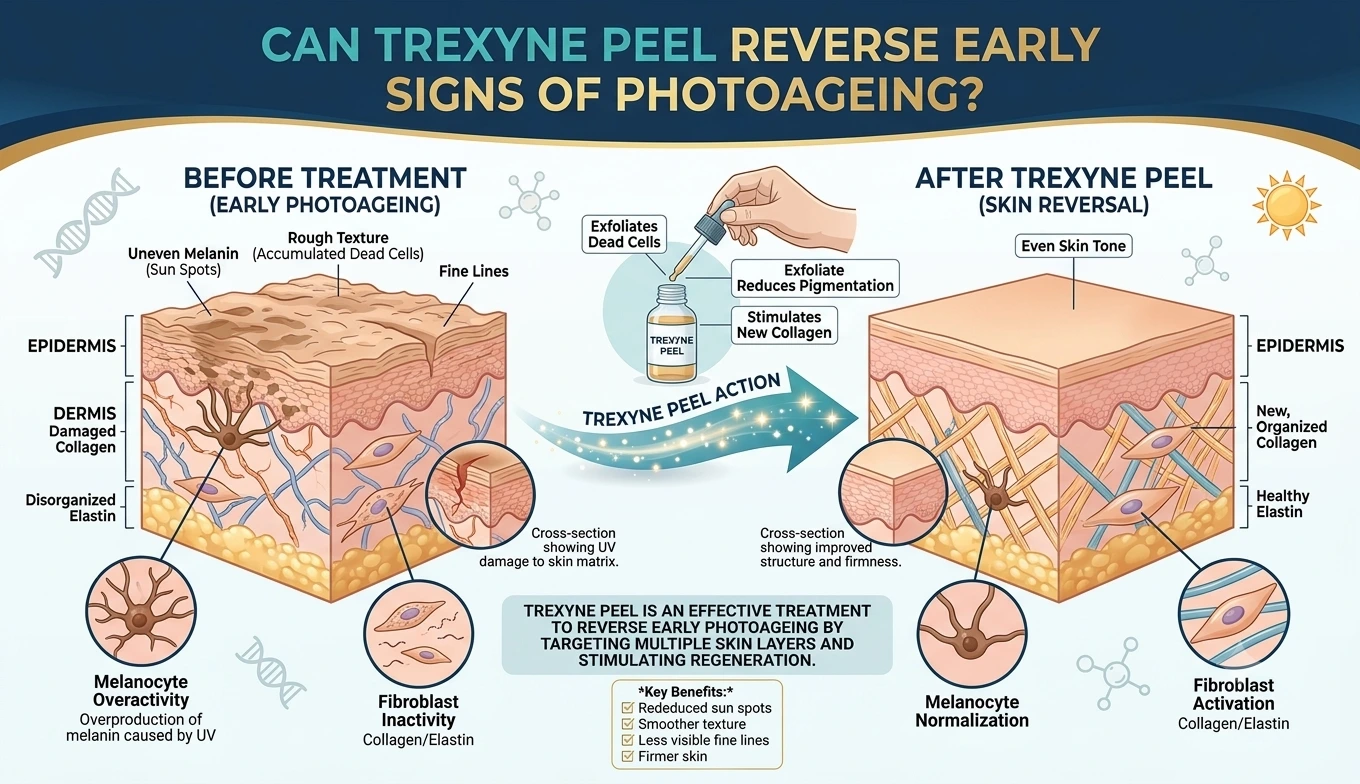
Can Trexyne Peel Reverse Early Signs of Photoageing?
Trexyne Peel cannot reverse photoageing, and no honest practitioner should claim any treatment can turn back time completely. What it can do is support a visibly smoother, more even-toned complexion by working on the skin’s surface through a purely mechanical resurfacing action. For clients showing early signs of sun-related ageing, such as fine lines, dullness, and patchy pigmentation, this approach may help refine texture and support the skin’s natural renewal process. You can view full treatment details on the Trexyne Peel product page before recommending it to clients.
What Is Photoageing and Why Does It Show Up Early?
Photoageing describes the changes that happen to skin after repeated exposure to UV light. Unlike chronological ageing, which follows a fairly predictable timeline shaped by genetics and time itself, photoageing can appear far earlier than a client expects. Someone in their late twenties or early thirties may already show signs that are usually associated with a much older skin profile.
This happens because UV exposure affects the skin at a structural level over time. Repeated sun exposure, even without visible burning, gradually changes how the skin behaves on the surface. Clients often describe this as their skin looking “tired” or “uneven” rather than specifically ageing, which is why early photoageing is so often missed or dismissed in a standard skincare routine.
Because the changes build up gradually, many clients do not connect the dots between years of sun exposure and the texture or tone they see in the mirror today. A practitioner’s role is often to help clients understand this connection, and to explain that the earlier these signs are addressed, the more manageable they tend to be.
Common Contributing Factors
Practitioners tend to see a combination of the following in clients presenting early signs:
- Frequent unprotected sun exposure, including daily incidental exposure
- Outdoor occupations or hobbies
- Minimal or inconsistent SPF use earlier in life
- Genetic sensitivity to UV damage
- Living in consistently sunny climates or high-altitude areas
- Frequent use of sunbeds earlier in life
Understanding the client’s exposure history helps a practitioner set realistic expectations and choose an appropriate treatment intensity. A client who spent years working outdoors without adequate protection will usually present differently to one whose exposure has been more occasional, and this should inform the treatment plan from the outset.
How Photoageing Differs From Chronological Ageing
It helps to separate photoageing from the natural ageing process during a client consultation, since the two are often confused. Chronological ageing happens to everyone regardless of lifestyle, and it tends to produce gradual, even changes across the whole face. Photoageing, by contrast, tends to be patchy and uneven, and it often affects some areas of the face far more than others, particularly those most exposed to the sun over the years.
This distinction matters clinically. A client dealing primarily with photoageing may respond well to a resurfacing-focused approach that targets the surface irregularities caused by sun exposure, whereas someone dealing mainly with chronological changes may need a broader conversation about their overall skincare strategy. Recognising which factor is dominant helps a practitioner recommend the most appropriate starting point.
In practice, most clients present with a mixture of both. A client in their forties may have genuine chronological changes alongside more pronounced photoageing on the areas of the face and neck that received the most sun exposure over the years. Separating these two influences during a consultation, even informally, helps the practitioner explain why a resurfacing treatment might make a more visible difference in some areas of the face than others.
The Early Signs Practitioners See Most Often
Early photoageing rarely presents as a single, obvious issue. It tends to show up as a cluster of small changes that, together, make the skin look less refined.
Rougher surface texture. Clients often mention that their skin no longer feels as smooth as it once did, even though they cannot always identify why. This is one of the earliest and most common complaints.
Uneven tone. A loss of even tone is frequently one of the first signs clients notice, particularly in natural daylight or when comparing recent photographs to older ones.
Faint pigmentation. Small areas of pigmentation may become more noticeable, especially after periods of increased sun exposure such as a summer holiday.
Fine lines around the eyes and mouth. These tend to appear earlier in areas where the skin is thinner and more expressive, and sun exposure can accelerate their appearance.
Reduced radiance. Clients may also mention that their skin no longer looks as luminous as it once did, even when their skincare routine has not changed.
Recognising these signs early gives practitioners the opportunity to introduce a resurfacing treatment before the changes become more established, which is often when clients are most receptive to trying something new.
It is worth noting that these signs rarely appear in isolation. A client mentioning dullness may not realise that the same underlying sun exposure has also contributed to the faint pigmentation they have started to notice, or the slight roughness they attribute to dry weather. Taking a step back during consultation to look at the fuller picture, rather than addressing each concern separately, often leads to a more effective treatment plan.
Why Mechanical Resurfacing Is a Different Approach
Many clients arrive at a consultation assuming that any resurfacing treatment must involve acids. It is worth explaining clearly that this is not the case with every option available in a clinic setting, and Trexyne Peel is a good example of this.
How Marine-Algae Spicules Work
Trexyne Peel uses marine-algae spicules to create controlled micro-channels in the skin’s surface. This is a physical, mechanical action rather than a chemical one. The spicules work directly on the surface layer, encouraging a controlled resurfacing effect without relying on chemical exfoliants of any kind.
Because the mechanism is mechanical, the practitioner has a high degree of control over the treatment. Intensity can be adjusted based on how the skin responds, which supports a more tailored approach than a fixed-strength formula might allow.
No Acids, No Chemical Exfoliation
There are no acids involved in this process and no chemical penetration takes place. This distinction matters for clients who have reacted poorly to chemical exfoliation in the past, or who are simply looking for an alternative mechanism that still delivers a visible improvement in texture and tone.
For clinics that regularly see clients with reactive or sensitised skin, having a mechanical, acid-free option available broadens the range of clients who can be offered a resurfacing treatment safely.
The Role of Stabilised Vitamin E in Recovery
Alongside the mechanical resurfacing action, Trexyne Peel is infused with stabilised tocopherol, a form of Vitamin E. This is included to support the skin’s recovery phase from the very first application.
For skin that has experienced years of UV exposure, supporting the recovery process after a resurfacing treatment is just as important as the resurfacing itself. Vitamin E is widely recognised within skincare formulation for its supportive role in the skin’s natural recovery, and its inclusion here is intended to work alongside the mechanical action rather than as a separate step.
This combined approach, mechanical resurfacing paired with a supportive ingredient built into the formula, means practitioners are not left to layer on additional recovery products immediately after treatment. The Vitamin E is already part of the process from the moment the peel is applied.
What Trexyne Peel Actually Offers Clinics
Understanding what the product is designed to do helps practitioners position it accurately with clients rather than over-promising results.
A Tiered Protocol Built for Flexibility
Trexyne Peel is designed around a tiered protocol, which allows a practitioner to match treatment intensity to a client’s specific skin type and expectations. A client with early, mild photoageing signs may need a lighter approach than a client with more established changes. This flexibility is one of the reasons the product suits a wide range of clinic clients, from those trying resurfacing for the first time to those already familiar with in-clinic treatments.
Predictable Downtime
One of the more practical benefits reported by practitioners is predictable downtime. Because the mechanism is mechanical rather than chemical, clients tend to have a clearer sense of what to expect after treatment, which supports better planning around social or professional commitments. This predictability also makes it easier for practitioners to advise clients confidently before their first session.
Building a Treatment Plan for Early Photoageing
A single session is rarely enough to address early photoageing on its own. Most practitioners build a short course of treatments, spaced appropriately, to allow the skin to respond and recover between sessions.
When planning a course with Trexyne Peel, practitioners typically consider the client’s skin type, the severity of the signs present, and how the skin responded to the first session before adjusting intensity for subsequent visits. This structured approach tends to produce a more considered outcome than a single, isolated treatment.
Spacing Sessions Appropriately
Spacing between sessions gives the skin time to complete its recovery phase before the next treatment. Practitioners generally assess this on a case-by-case basis, taking into account how the client’s skin responded previously and whether any sensitivity was noted.
Clinics can review the full range of options, including multi-session packages, on the Trexyne shop page, which makes it easier to plan a course in advance and discuss pricing with clients upfront.
Who Is a Good Candidate for This Treatment
Trexyne Peel is designed exclusively for use by trained aesthetic professionals, so every application takes place within a clinical setting. Within that context, it tends to suit clients who are noticing early textural or tonal changes and want a resurfacing option that avoids chemical exfoliation.
It is not intended for home use under any circumstances, and practitioners should be clear with clients that results and suitability will always depend on an individual skin assessment carried out in clinic.
When a Consultation Is Essential
Before any treatment, a thorough consultation should cover the client’s skin history, current skincare routine, sun exposure habits, and any previous reactions to resurfacing treatments. This conversation allows the practitioner to select an appropriate protocol tier and set realistic expectations from the outset.
A good consultation also gives the practitioner an opportunity to explain the mechanical mechanism clearly, particularly for clients who may be more familiar with chemical peels from previous experience elsewhere. Taking the time to walk through how marine-algae spicules differ from a chemical formula often reassures clients who are cautious after a previous reaction, and it sets accurate expectations for what they will feel during and after the session.
Practitioners should also use the consultation to confirm there is nothing in the client’s current routine or medical history that would make them unsuitable for treatment on the day. This is a standard part of responsible practice for any in-clinic resurfacing treatment, and it should never be skipped in favour of moving straight to treatment.
What Clients Can Expect During and After Treatment
Setting accurate expectations before, during, and after a session helps clients feel informed and supported throughout their course of treatment.
During the Session
Because Trexyne Peel works mechanically, the sensation during treatment is generally described as a controlled, physical resurfacing rather than a chemical sting or burning sensation. The practitioner adjusts pressure and intensity according to the protocol tier selected for that client.
Immediately Afterwards
Clients should be advised on what is normal to see and feel in the hours following treatment, including any mild redness or sensitivity, and how this typically settles. Predictable downtime, as noted earlier, makes this conversation more straightforward than it might be with less consistent treatments.
Aftercare and Supporting Long-Term Results
Aftercare guidance should always be tailored to the individual client and the protocol tier used, but general principles apply across most cases. Gentle skincare, consistent SPF use, and avoiding unnecessary sun exposure in the days following treatment all support the skin’s recovery phase.
Because photoageing is driven by cumulative UV exposure, ongoing sun protection remains one of the most important factors in maintaining results over time. A resurfacing treatment can support a more even, refined-looking complexion, but daily sun protection is what helps preserve that improvement between sessions and beyond the course itself.
Practitioners are well placed to reinforce this message at every visit, since clients are often more receptive to sun protection advice immediately after seeing the visible benefits of a treatment.
Why Practitioner-Only Access Matters
Trexyne Peel is sold strictly to verified practitioners and clinics, which keeps every application within a professional, supervised environment. This matters particularly for skin that is already showing signs of photoageing, as an experienced eye can assess sensitivity, adjust intensity, and monitor how the skin responds throughout a course of treatments.
This professional-only model also supports consistency. Because the product is never sold for home use, practitioners can be confident that every client’s experience with Trexyne Peel has been guided by trained hands, from the initial consultation through to aftercare advice.
Clinics interested in stocking Trexyne Peel or discussing suitability for their client base can get in touch directly via the Trexyne contact page. For a broader look at the brand’s approach to botanical, mechanical resurfacing, visit the Trexyne homepage.
Conclusion
Early photoageing tends to show up as a combination of rougher texture, uneven tone, faint pigmentation, and fine lines, often well before a client expects to see these changes. While no treatment can fully reverse the effects of UV exposure, Trexyne Peel offers clinics a mechanical, acid-free resurfacing option that may help support a smoother, more even-looking complexion over a structured course of treatments. Its tiered protocol allows practitioners to match intensity to each client’s skin, while the infused stabilised Vitamin E supports the skin’s recovery phase from the first session. For clients noticing the earliest signs of photoageing, this combination offers a considered, professional-led route to visibly refreshed skin, without chemical exfoliation and without unrealistic promises.
Frequently Asked Questions
Q: Can Trexyne Peel completely reverse sun damage?
No treatment can completely reverse sun damage. Trexyne Peel is designed to support a smoother, more even-looking complexion through mechanical resurfacing, and results should always be discussed as part of a realistic, individual consultation.
Q: Is Trexyne Peel a chemical peel?
No. Trexyne Peel works through a purely mechanical mechanism using marine-algae spicules to create controlled micro-channels. It does not involve acids or chemical exfoliation of any kind.
Q: How many sessions are usually needed to see an improvement in early photoageing signs?
This varies by client and by the tier of protocol used, but most practitioners plan a short course of sessions rather than relying on a single treatment. A consultation will help determine the right approach for each client’s skin.
Q: Is Trexyne Peel suitable for early signs of photoageing, or only more advanced cases?
Its tiered protocol means intensity can be matched to the client, which makes it suitable for early, mild signs as well as more established changes, depending on the practitioner’s assessment.
Q: What does the Vitamin E in Trexyne Peel actually do?
The stabilised tocopherol is included to support the skin’s recovery phase from the first application, working alongside the mechanical resurfacing action rather than as a separate treatment step.
Q: Can clients use Trexyne Peel at home between clinic visits?
No. Trexyne Peel is designed exclusively for use by trained aesthetic professionals and is not intended for home use under any circumstances.
Q: How can a clinic start offering Trexyne Peel to clients?
Clinics can review treatment and package options on the Trexyne shop page or get in touch via the contact page to discuss suitability, pricing, and next steps.