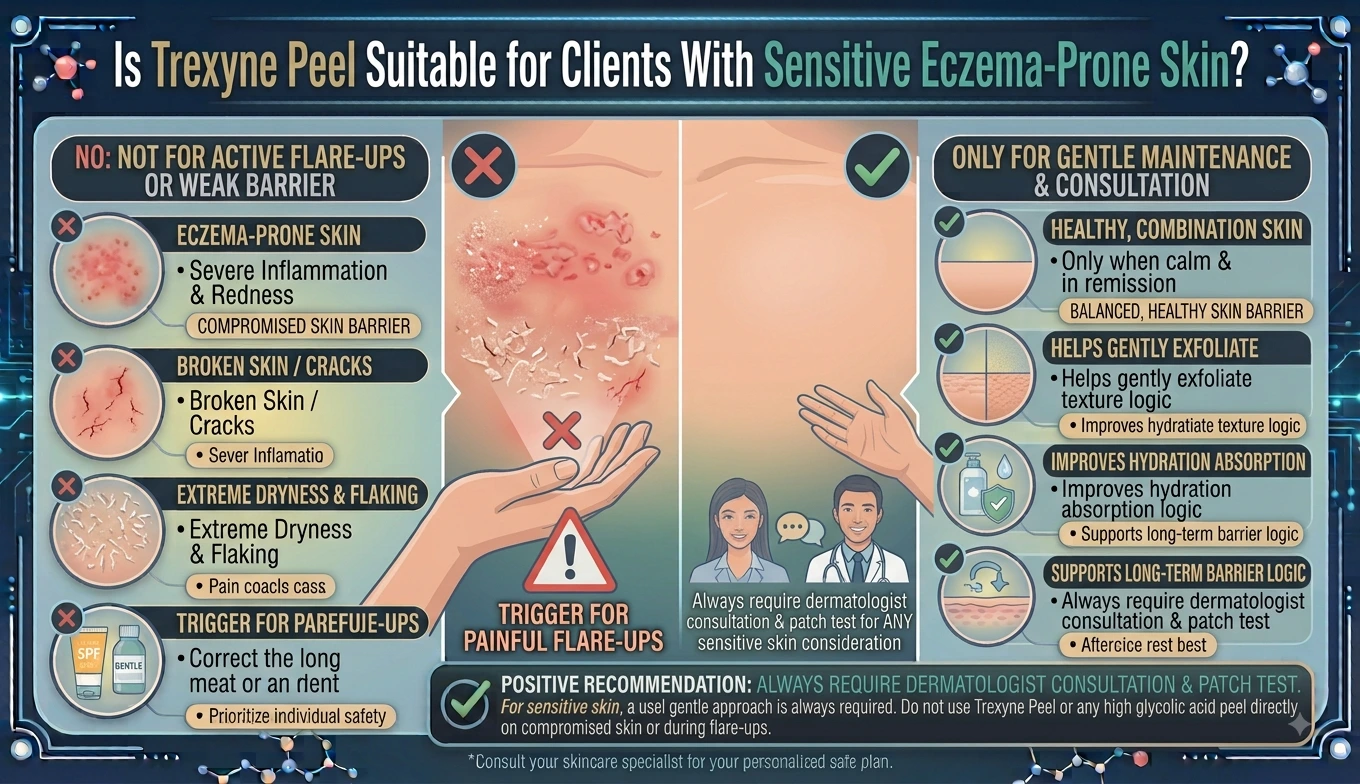
Is Trexyne Peel Suitable for Clients With Sensitive Eczema-Prone Skin ?
Yes, the Trexyne Peel can be suitable for clients with sensitive, eczema-prone skin, provided their skin is currently in a stable, non-flare phase and the treatment is administered using a gentle protocol. Eczema-prone complexions possess a compromised lipid barrier, making them highly vulnerable to harsh environmental stressors and intense treatments. Incorporating the Trexyne Peel Professional Algae Resurfacing Treatment
allows trained aesthetic professionals to offer controlled epidermal resurfacing without relying on chemical exfoliants. Utilizing microscopic marine spicules to create gentle physical micro-channels alongside stabilised Vitamin E to nourish the barrier, Trexyne Peel supports natural cellular turnover while maintaining moisture stability. This mechanical approach offers practitioners a predictable way to refine skin texture and boost radiance safely for sensitive clients.
Understanding the Characteristics of Eczema-Prone Skin
Working with eczema-prone tissue requires a clear understanding of its structural vulnerabilities. Aesthetic professionals must carefully evaluate barrier function before introducing any resurfacing protocol.
Lipid Barrier Impairment and Moisture Retention Loss
Eczema-prone skin inherently suffers from structural defects within the intercellular lipid matrix of the stratum corneum. The natural ceramide levels are reduced, leading to an unstable lipid arrangement that allows essential water to escape rapidly. This elevated transepidermal water loss creates persistent dryness, tightness, and fine surface scaling. When the lipid barrier is compromised, the skin loses its natural resilience, making cautious product selection paramount.
Hyper-Reactivity and Inflammation Vulnerability
Due to a weakened outer layer, sensitive skin permits easy penetration of environmental allergens and irritants. This heightened permeability triggers frequent inflammatory signals, leading to localized redness, itching, and uncomfortable sensations. Practitioners must avoid aggressive procedures or harsh formulations that disrupt this delicate surface equilibrium, focusing instead on methods that support mechanical renewal without triggering barrier distress.
The Mechanical Safety of Marine Algae Spicules for Sensitive Skin
Addressing textural roughness on sensitive skin demands a treatment method that works strictly through physical mechanisms without inducing chemical stress.
Non-Chemical Physical Micro-Channeling
The core innovation of Trexyne Peel rests on micronized, needle-like spicules derived naturally from marine algae. During clinical application, a practitioner gently massages these botanical spicules into the stratum corneum. The spicules create thousands of microscopic, physical channels within the upper epidermal layers. This entirely mechanical interaction dislodges loose, dead cells without altering skin pH or causing chemical irritation to delicate tissue.
Encouraging Orderly Cellular Migration
Once embedded in the upper skin layers, the marine spicules stimulate a natural self-repair response. Lower epidermal layers respond by accelerating keratinocyte production, which naturally pushes older cells and spicules outward. This physical desquamation unfolds predictably over several days. Because the mechanism relies entirely on natural cell movement, sensitive skin experiences a gentle, controlled resurfacing phase without sudden surface disruption.
The Essential Barrier Support of Stabilised Vitamin E
For eczema-prone complexions, resurfacing must always be paired with immediate, high-performance barrier support to prevent post-treatment dryness.
Immediate Lipid Replenishment with Tocopherol
The Trexyne Peel formulation integrates stabilised Vitamin E, also known as tocopherol, directly into its spicule carrier matrix. Tocopherol is a lipid-compatible antioxidant that integrates seamlessly into the intercellular lipid layers during application. As the marine spicules engage the upper tissue, stabilised Vitamin E immediately delivers essential lipid nourishment, comforting fragile skin from the very first touch.
Mitigating Moisture Loss During Desquamation
By supporting the stratum corneum during physical stimulation, stabilised Vitamin E helps lock in vital hydration and lowers transepidermal water loss. This antioxidant protection reduces surface redness and keeps newly revealed tissue soft and flexible throughout the recovery phase. Practitioners seeking professional botanical supplies for sensitive skin clients can view our offerings on the official Trexyne shop page
.
Protocol Selection: Customising Treatment Tiers for Delicate Complexions
Adapting treatment parameters to match sensitive skin tolerance is critical for achieving excellent aesthetic outcomes without risking irritation.
The Value of Level 1 Gentle Protocols
Trexyne Peel features a flexible, tiered protocol framework that empowers practitioners to control treatment depth precisely. For sensitive, eczema-prone skin, practitioners should always select a Level 1 protocol. This gentle entry tier utilizes light physical pressure and a shorter massage duration, allowing the practitioner to introduce marine spicules smoothly while maintaining complete comfort.
Avoiding High-Intensity Application Tiers
While higher protocol tiers deliver deeper exfoliation for coarse or weathered complexions, they are unsuitable for eczema-prone skin. Applying firm pressure or prolonged massage can over-stimulate delicate capillaries and stress a fragile barrier. Keeping application light ensures the client enjoys effective surface refinement, smoother texture, and enhanced glow while minimizing the risk of prolonged erythema.
Clinical Screening: Identifying Suitable Candidates versus Active Flares
Selecting the right moment to perform a resurfacing treatment is just as important as the technique itself when managing eczema-prone clients.
Contraindications During Active Eczema Outbreaks
It is vital to emphasize that Trexyne Peel must never be applied to skin experiencing an active eczema flare. Signs of an active flare include visible weeping, open micro-cracks, severe redness, intense itching, or raw patches. Applying any physical resurfacing treatment to compromised, broken skin can exacerbate discomfort and compromise healing. Treatments must be postponed until the skin returns to a fully calm state.
Evaluating Skin Stability During Consultation
During the initial consultation, the aesthetic professional must thoroughly assess the client’s current skin status. The practitioner should confirm that the skin barrier is intact, calm, and free of localized inflammatory lesions. Once barrier stability is established, the practitioner can proceed safely with a customized Level 1 treatment plan to refine rough, flaky texture.
Comparing Marine Spicules with Manual Facial Scrubs for Sensitive Tissue
Understanding why professional marine spicule technology outperforms retail manual scrubs reveals why it is far safer for sensitive complexions.
Clean Physical Channels versus Harsh Friction Trauma
Retail facial scrubs frequently rely on irregular materials such as crushed nutshells, sugar, or jagged mineral granules. When rubbed onto sensitive skin, these sharp edges create uneven micro-tears, drag across delicate areas, and trigger immediate localized inflammation. In contrast, micronized marine spicules enter the upper stratum corneum cleanly, creating uniform micro-channels without tearing or scraping the surface.
Internal Cellular Drive versus Surface Abrasion
Traditional manual scrubs attempt to scrape dead cells off the surface through harsh external friction. Marine spicules work from within by temporarily resting in the upper epidermis to signal natural cell movement. As fresh keratinocytes ascend, dead, dry surface cells detach naturally and evenly, preventing the barrier trauma associated with manual home scrubbing.
Post-Treatment Care for Eczema-Prone Skin
Guiding sensitive skin clients through proper post-treatment care ensures the renewing skin barrier stays protected, calm, and thoroughly hydrated.
Simple, Lipid-Rich Home Aftercare Protocols
Following a professional resurfacing session, clients must follow a strict, minimalist home care routine. Cleansing should involve only cool or lukewarm water paired with a gentle, non-foaming cleanser. Clients should frequently apply a rich, simple moisturizer packed with soothing lipids to nourish the stratum corneum and keep shedding tissue supple during the desquamation phase.
Essential Broad-Spectrum Photoprotection
Freshly resurfaced skin requires diligent defense against solar radiation, which can easily trigger sensitivity in renewing tissue. Clients must apply a high-protection, broad-spectrum sunscreen every morning throughout the recovery period. Protecting new epidermal cells preserves barrier harmony and maintains a luminous, comfortable complexion. Practitioners requiring clinical guidance or protocol documentation can reach out through our official Trexyne contact page
.
Integrating Trexyne Peel into a Long-Term Sensitive Skincare Plan
Achieving long-term smoothness and barrier harmony for sensitive clients requires a thoughtful, multi-session strategy managed by an experienced practitioner.
Conducting Patch Testing and Cautious Progression
Before commencing a full-face treatment, practitioners working with ultra-sensitive clients may perform a small patch test behind the ear or along the jawline. Observing the skin for twenty-four to forty-eight hours confirms individual tolerance. Once verified, the practitioner can schedule initial sessions using the lowest intensity tier to build skin resilience gradually.
Establishing Safe Session Intervals
To maintain optimal barrier health, resurfacing sessions for sensitive, eczema-prone skin should be spaced further apart than standard treatments. Allowing four to six weeks between appointments ensures the lipid matrix has ample time to rest, rebuild, and stabilize completely. Over time, controlled mechanical renewal helps smooth persistent dry scaling and restores a healthier, more luminous appearance. Explore our full range of professional botanical treatments on the main Trexyne homepage
.
Conclusion
Trexyne Peel is a suitable and effective resurfacing option for clients with sensitive, eczema-prone skin when applied during stable, non-flare periods using a gentle protocol. Sensitive skin requires a delicate balance of gentle desquamation and immediate barrier support to overcome persistent dryness and rough texture. By utilizing the purely mechanical action of marine-algae spicules, the Trexyne Peel Professional Algae Resurfacing Treatment
creates controlled physical micro-channels that encourage natural cellular movement without chemical exfoliants. Infused with stabilised Vitamin E to nourish the stratum corneum and maintain moisture stability, this botanical treatment offers predictable recovery and customizable tiered protocols. Guided by expert practitioner assessment and disciplined aftercare, Trexyne Peel helps sensitive skin clients achieve a smoother, clearer, and more radiant-looking complexion safely.
Frequently Asked Questions
Q: Can Trexyne Peel be used on a client during an active eczema flare-up?
No, Trexyne Peel should never be applied to skin experiencing an active eczema flare-up, open cracks, weeping lesions, or severe inflammation. Treatment should only take place when the skin barrier is calm, intact, and in a stable condition.
Q: Why is a mechanical marine spicule treatment safer for sensitive skin than chemical exfoliants?
A mechanical spicule treatment works purely through physical micro-channels to stimulate natural cellular turnover. It does not alter skin pH, penetrate chemically, or cause the harsh surface burning often associated with chemical exfoliants on delicate, eczema-prone skin.
Q: How does stabilised Vitamin E support eczema-prone skin during the Trexyne Peel treatment?
Stabilised Vitamin E provides immediate lipid nourishment directly to the stratum corneum during application. It helps reinforce the compromised skin barrier, reduces transepidermal water loss, and maintains comfort throughout the physical shedding phase.
Q: What protocol tier should an aesthetic practitioner choose for a sensitive, eczema-prone client?
Practitioners should always select a Level 1 protocol for sensitive or eczema-prone complexions. This entry tier uses light physical pressure and shorter contact time to deliver gentle surface refinement while preserving barrier integrity.
Q: Can clients with eczema purchase Trexyne Peel for home application to treat dry patches?
No, Trexyne Peel is strictly a professional-only treatment available exclusively to verified clinics and trained aesthetic practitioners. Safe application on sensitive skin requires professional barrier assessment, controlled pressure, and expert protocol knowledge.
Q: How long should an eczema-prone client wait between Trexyne Peel sessions?
Sensitive or eczema-prone clients should wait approximately four to six weeks between treatment sessions. This extended recovery window gives the delicate lipid barrier plenty of time to rest, rebuild, and fully re-establish its natural protective function.