What Is the Recommended Gap Between Peel Sessions?
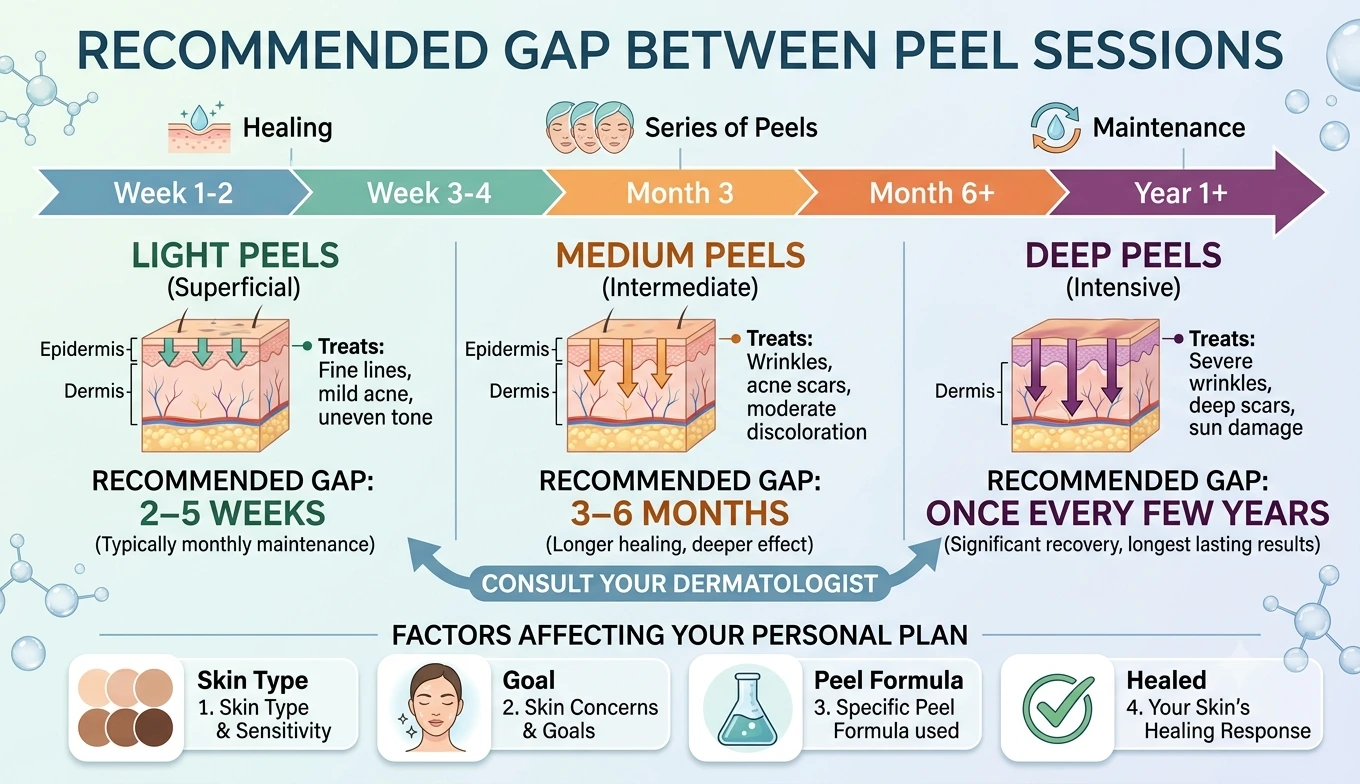
The recommended gap between peel sessions is typically several weeks, allowing the skin enough time to complete its natural renewal cycle before the next treatment begins. There is no single number that suits every client, because the right interval depends on skin type, the intensity used, and how the skin has responded to previous sessions. Getting this spacing right matters just as much as the treatment itself, since sessions booked too close together can leave the skin without enough time to recover, while sessions spaced too far apart can slow progress unnecessarily. The Trexyne Peel is built with a tiered protocol that helps practitioners judge this spacing with more confidence, matching intensity and interval to what each client’s skin can genuinely handle.
Why Spacing Between Sessions Matters So Much
The renewal cycle sets the pace
Skin renews itself on its own timeline. New cells move from the deeper layers of the epidermis up towards the surface over a period of several weeks, and this process cannot be rushed by booking appointments closer together. A resurfacing treatment works with this cycle rather than against it, which means the gap between sessions needs to respect how long that renewal genuinely takes.
This cycle also tends to slow as clients get older, which is worth bearing in mind when planning a course for a more mature client. A schedule that suited a client in their twenties may not be appropriate for a client in their fifties, even if the treatment goal looks similar on paper.
Recovery is part of the result
The days immediately after a session are when the skin does much of its visible work, settling, refining, and beginning to look smoother. Interrupting that process with another treatment too soon does not speed up results. It simply asks the skin to start a new recovery phase before the last one has finished, which tends to work against the outcome the client is hoping for.
Practitioners who have worked with a range of clients will often recognise the difference between skin that has been given proper time to recover and skin that has been treated too frequently. The former tends to look calmer and more consistent from session to session, while the latter can appear more reactive, even if the underlying treatment plan was well intentioned.
What Happens if Sessions Are Booked Too Close Together
Booking sessions closer together than the skin can comfortably manage increases the likelihood of irritation, sensitivity, and prolonged redness. Instead of building progress, back-to-back sessions can leave the skin in a constant state of recovery, which makes it harder for a practitioner to judge how well the treatment is actually working. It also makes it more difficult to build an accurate picture of progress, since the skin never gets a proper baseline between appointments to compare against.
There is also a practical consequence worth mentioning to clients directly. Skin that is not given enough time to recover can start to look tired or uneven in a different way, quite separate from the concern the course was meant to address. This is rarely the outcome anyone is hoping for, and it usually takes longer to resolve than it would have taken to simply follow a properly spaced schedule from the beginning.
Why patience protects results
Clients are sometimes keen to speed things up, particularly ahead of an event or occasion. It is worth explaining early on that rushing the schedule tends to work against the result they want. A course that respects proper spacing, even if it takes a little longer overall, is far more likely to deliver a smooth, even-looking outcome than one that has been compressed for the sake of speed.
What Happens if Sessions Are Spaced Too Far Apart
The opposite problem also exists. If sessions are spread too far apart, momentum can be lost between appointments, and it may take longer for a course to build towards a noticeable, cumulative result. This does not cause any harm to the skin, but it can mean the overall course takes considerably longer to complete than necessary, and clients may lose motivation if they feel progress has stalled.
Long, inconsistent gaps can also make it harder to track progress accurately. If too much time passes between sessions, it becomes difficult to tell whether an improvement is genuinely the result of the treatment plan or simply the skin’s own natural fluctuation over time. Reasonably consistent spacing helps keep the picture clear for both the practitioner and the client.
Finding the balance
The ideal gap sits somewhere between these two extremes, close enough to maintain momentum and build on previous sessions, but far enough apart to give the skin proper time to recover fully. This is exactly the kind of judgement a tiered protocol is designed to support, since it allows the practitioner to adjust both intensity and spacing based on how the client’s skin is actually responding.
How the Trexyne Peel’s Tiered Protocol Supports Better Spacing Decisions
The Trexyne Peel works through marine-algae spicules that create controlled micro-channels in the skin, with no chemical exfoliants involved at any stage. Because this mechanism is entirely mechanical, practitioners have direct control over the intensity applied in each session, which has a knock-on effect on how much recovery time the skin will need before the next appointment.
A tiered protocol means that a gentler session, used earlier in a course or for more sensitive skin, may allow for a shorter interval before the next visit. A more intensive session, used later in a course once tolerance has been established, may call for a slightly longer gap. This flexibility is one of the more practical benefits of a mechanical, adjustable treatment, since it allows spacing to be tailored rather than fixed.
Vitamin E and the recovery window
Stabilised tocopherol is infused into the Trexyne Peel to support the skin’s recovery phase from the very first application. Supporting recovery in this way can make the days following a session more comfortable, which in turn plays a role in how the practitioner assesses when the skin is ready for its next appointment.
Factors That Influence the Ideal Gap Between Sessions
Skin type and sensitivity
Clients with more resilient skin may tolerate a shorter interval between sessions than those with sensitive or reactive skin. This is very individual, and it often becomes clearer after the first one or two sessions of a course, once the practitioner has a better sense of how that particular client’s skin responds and recovers.
It is worth remembering that skin type is not always fixed. A client’s skin can become more or less reactive over time, influenced by factors such as stress, weather, or changes in their general skincare routine. Reassessing sensitivity at each visit, rather than assuming it will stay the same throughout the course, helps keep the spacing decision accurate as the course progresses.
Intensity of the previous session
A higher intensity session generally calls for a longer gap before the next appointment, simply because there is more renewal work for the skin to complete. This is one of the clearest practical reasons why the tiered approach built into the Trexyne Peel is useful, as it lets the practitioner scale both intensity and spacing together rather than treating them as separate decisions.
In practice, this often means the gap between the first and second session of a course looks different to the gap between the fourth and fifth. As intensity is adjusted in response to how the skin has been coping, the interval naturally shifts alongside it, which is exactly the kind of flexibility a tiered protocol allows for.
The treatment goal
Clients working towards a specific concern, such as an uneven-looking texture or a dull complexion, may follow a slightly different spacing pattern than those on a general maintenance plan. A course built around a clear goal tends to benefit from more consistent, closely monitored spacing in the earlier stages, with intervals potentially widening as the course progresses and the concern improves.
Client lifestyle and downtime tolerance
Some clients need to plan sessions around work commitments, social events, or how visible any redness might be in the days afterwards. While the biological recovery timeline should always come first, discussing lifestyle factors at consultation helps set a schedule the client can actually stick to, which matters just as much as getting the physiological spacing right.
Clients who travel frequently for work, or who have irregular schedules, may need a more flexible approach to booking than clients with a predictable weekly routine. Building this kind of flexibility into the plan from the start, rather than trying to fit an inflexible schedule around an unpredictable diary, tends to result in a course that actually gets completed rather than abandoned partway through.
Setting a Realistic Session Schedule at Consultation
Starting with an honest conversation
The best time to discuss spacing is before the course even begins, not after the first session when a client is already asking when they can come back. Setting out a rough schedule from the outset, while being clear that it may be adjusted based on how the skin responds, helps manage expectations from day one.
This conversation also gives the practitioner a chance to ask about the client’s diary constraints early, rather than discovering a scheduling conflict halfway through a course. A client who knows in advance roughly how many appointments to expect, and roughly how far apart they will fall, is far better placed to commit to the full plan.
Building in flexibility
Even with a plan in place, spacing should never be treated as fixed in stone. If a client’s skin is taking longer to settle than expected, pushing the next appointment back protects both comfort and results. Equally, if recovery has gone smoothly, there may be room to keep sessions moving along at a steady, previously agreed pace.
Using photographs to guide timing decisions
Comparing photographs from session to session gives a much clearer, more objective view of how the skin is progressing than relying on memory or impression alone. This can be a useful tool when deciding whether to stick to the planned interval or adjust it slightly based on how visible the improvement has been.
Photographs are also a helpful way to reassure clients who feel their course is progressing more slowly than expected. Seeing a side-by-side comparison often reveals more change than the client had noticed day to day, which can support their confidence in staying with the planned schedule rather than pushing for a faster pace.
Common Mistakes Practitioners Make With Session Spacing
Following a rigid schedule regardless of skin response
Applying the same interval to every client, regardless of how their skin has actually responded, is one of the more common pitfalls. A schedule that works well for one client may be too fast or too slow for another, even if they are having the same treatment. Reviewing progress at each visit, rather than working purely from a calendar, tends to produce more consistent results across a client base.
Giving in to pressure for faster results
Clients under time pressure, perhaps ahead of a wedding or another event, may ask to have sessions moved closer together. It is worth being clear and confident in these conversations, explaining that shortening the gap is more likely to compromise the result than improve it. A practitioner who holds this line, kindly but firmly, tends to build more trust over time than one who bends the schedule to meet unrealistic timelines.
Not adjusting spacing as the course progresses
The right interval at the start of a course is not necessarily the right interval by the end. As tolerance builds and results begin to show, spacing may need to be reviewed and adjusted. Treating the schedule as a living plan, rather than something fixed at the first consultation, tends to serve both the client and the outcome better.
Seasonal and Practical Considerations for Scheduling
Time of year
The season can play a small but genuine role in how a schedule is planned. Clients are often more mindful of sun exposure during the summer months, which can influence how comfortable they feel about the visible aftermath of a session. Discussing this at consultation, and planning the schedule around periods where SPF use and sun avoidance are more realistic for the client, can support a smoother course overall.
Record keeping across a course
Keeping clear notes on the date, intensity, and skin response for each session makes it far easier to judge when the next appointment should be booked. Over the course of several sessions, these notes build into a useful reference that helps refine the spacing for that specific client, rather than relying on memory or a generic rule of thumb.
Communicating changes to the client
If a practitioner decides to adjust the planned interval, whether lengthening or shortening it slightly, it helps to explain why. Clients who understand the reasoning behind a schedule change tend to trust the process more than those who are simply told a new date without context. A short, clear explanation is usually all that is needed.
How to Talk to Clients About Session Spacing
Avoiding vague timelines
Telling a client to simply “come back in a few weeks” can leave room for confusion and inconsistent bookings. Giving a specific, recommended interval, while explaining that it may be adjusted based on how the skin responds, gives the client something concrete to work with when planning their diary.
Managing expectations around visible results
Clients sometimes expect to see a dramatic change immediately after each session, particularly if they have seen quick transformations described elsewhere. Explaining that results build gradually across a properly spaced course, rather than appearing in a single dramatic reveal, helps clients feel confident in the process even when changes are subtle from one appointment to the next.
Building Spacing Into a Wider Aftercare Routine
The gap between sessions is only part of the picture. What happens during that gap matters too. Encouraging clients to use SPF daily, keep their skincare routine gentle, and avoid unnecessary sun exposure between appointments all support the work being done in clinic. A well-spaced course paired with sensible aftercare tends to produce a more comfortable experience and a more even-looking result by the end of the plan.
Clinics interested in reviewing pricing and pack sizes for building a course-based protocol can find full details via the shop, and practitioners with specific questions about structuring a treatment plan are welcome to reach out through the contact page. General information about the brand and its approach is available on the Trexyne homepage.
Conclusion
The gap between peel sessions is not a fixed number, but it is one of the most important decisions in building an effective course. Spacing sessions too closely risks irritation and disrupts recovery, while spacing them too far apart can slow progress and reduce momentum. The right interval sits between these extremes and depends on skin type, treatment intensity, and how each individual client responds. The Trexyne Peel’s mechanical, tiered protocol gives practitioners the flexibility to judge this spacing with confidence, working through marine-algae spicules and stabilised Vitamin E to support skin renewal at a pace that suits the client. A thoughtfully spaced course, built around realistic timelines rather than rushed expectations, can support a brighter, more even-looking complexion over time.
FAQs
Q: How many weeks should I leave between Trexyne Peel sessions?
The ideal gap depends on the individual client, including their skin type and the intensity used in the previous session. A practitioner will typically recommend an interval that allows the skin’s natural renewal cycle to complete before the next appointment.
Q: Can I have peel sessions closer together to see faster results?
Booking sessions too close together is not usually recommended, as it does not give the skin enough time to recover fully. This can increase the risk of irritation rather than speeding up the overall result.
Q: Does the gap between sessions change throughout a course?
Yes, spacing can be adjusted as a course progresses. Earlier sessions may call for closer monitoring, while later sessions might follow a slightly different interval depending on how the skin has responded up to that point.
Q: What happens if I leave too long a gap between sessions?
Leaving a longer gap than necessary will not harm the skin, but it may mean the course takes longer overall to build towards a noticeable, cumulative result.
Q: Does skin sensitivity affect how long I should wait between sessions?
Yes, clients with more sensitive or reactive skin may need a longer interval between sessions than those with more resilient skin, which is part of why an individual consultation is so important.
Q: Is the recommended gap the same for every client?
No, spacing is personalised based on factors such as skin type, treatment intensity, and how the client’s skin has responded to previous sessions, rather than following a single fixed rule for everyone.
Q: Who can advise me on the right session schedule for my skin?
A trained practitioner offering the Trexyne Peel can assess your skin and recommend a suitable schedule. You can find a stockist or get in touch through the contact page, or browse further details via the shop.