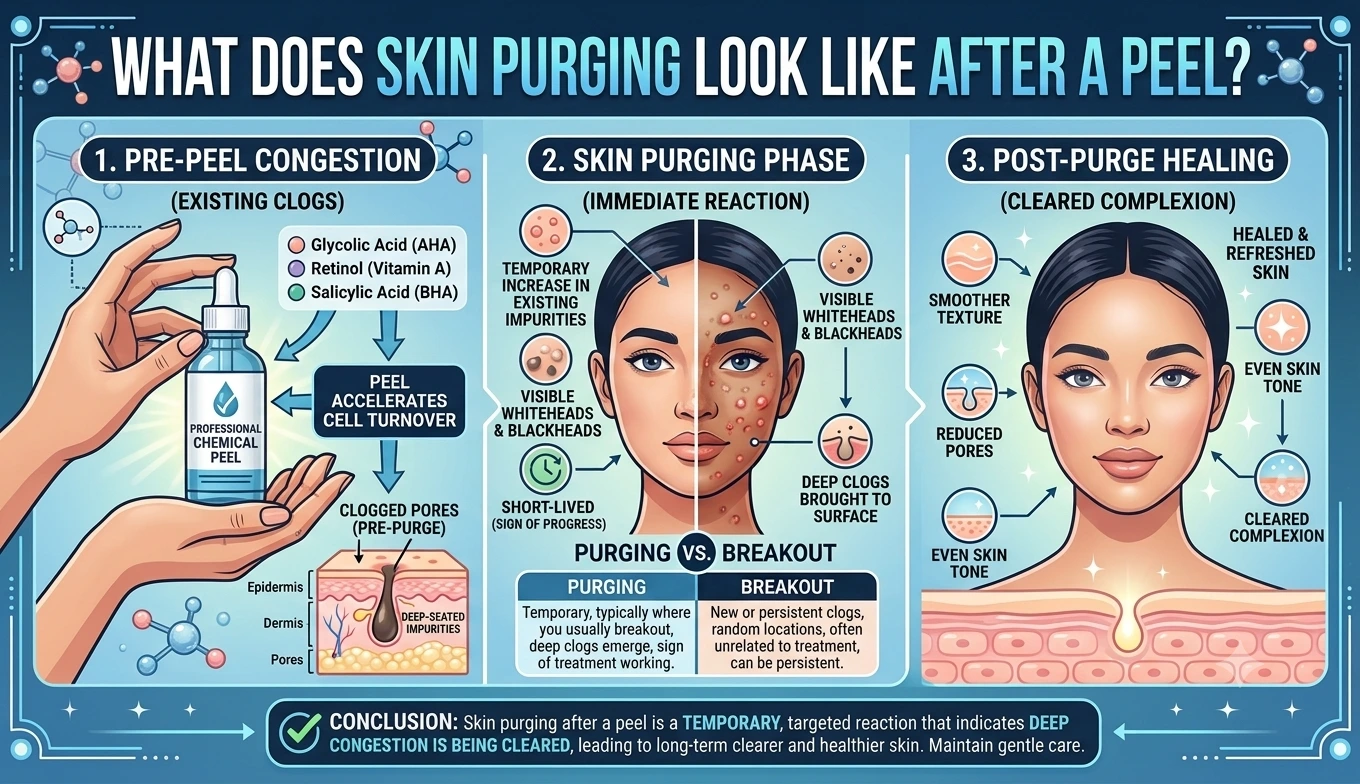
What Does Skin Purging Look Like After a Peel?
Skin purging after a resurfacing treatment usually appears as small, superficial bumps, mild flaking or a slightly congested texture that settles within one to two weeks. It happens because the skin’s renewal cycle speeds up, pushing existing congestion to the surface faster than usual. This is different from a true breakout, which tends to appear in new areas and lingers far longer. Many clients booking a Trexyne Peel ask what to expect in the days that follow, and understanding the difference between purging and irritation helps set realistic expectations before and after every session. As a practitioner, explaining this clearly at consultation stage avoids unnecessary worry and builds trust in the process.
Understanding Skin Purging: What It Actually Means
Purging is a term used to describe the skin’s response to accelerated cell turnover. When a resurfacing treatment encourages the skin to renew itself more quickly, congestion that was already forming beneath the surface can be brought up sooner than it would have appeared naturally. This is not new damage. It is existing material making its way out in a compressed timeframe.
Clients sometimes assume that any change in their skin after a treatment means something has gone wrong. Part of a practitioner’s role is to reframe this. Purging is generally a sign that the skin’s renewal process has been activated, not that the treatment has caused harm. It tends to resolve on its own as the skin completes its natural cycle.
Why the Term Gets Misused
Not every post-treatment reaction is purging. The word gets applied loosely, sometimes to describe genuine irritation or a reaction to an unsuitable product. A careful practitioner distinguishes between the two by looking at location, appearance and how the skin responds over the following days.
This is particularly important in a clinic setting, where a client’s confidence in a treatment can be shaken if they mistake a normal, temporary response for a problem. Taking the time to explain what purging is, and why it happens, at the point of consultation rather than after the fact tends to lead to calmer, more informed clients. Written aftercare notes summarising what to expect in the days following treatment can reinforce this conversation and give clients something to refer back to if they feel unsure.
Why Understanding This Matters for Practitioners
For practitioners, being able to explain purging clearly is also a professional skill in its own right. Clients are far more likely to trust a clinic that can confidently talk through what is happening to their skin, rather than one that seems uncertain or dismissive of their questions. Building this knowledge into every consultation, not just for resurfacing treatments but across a clinic’s wider treatment menu, helps establish a reputation for thorough, honest care.
How Purging Differs From a Breakout
This is one of the most common questions raised in the treatment room. The two can look similar at first glance, but there are consistent differences worth understanding.
Purging tends to appear in areas where the client already experiences some congestion, such as the chin, jawline or forehead. It is usually made up of small, non-inflamed bumps or slight roughness rather than deep, painful spots. Crucially, it resolves faster than a typical breakout, generally settling within one to two weeks.
A genuine breakout, by contrast, can appear in new areas the client does not usually struggle with. It often involves larger, more inflamed lesions and does not follow the same predictable timeline. If new blemishes are still appearing well beyond the expected purging window, it is worth reviewing the client’s current skincare routine and treatment plan.
It can help to walk clients through a simple mental checklist during a follow-up conversation. Where is the congestion appearing, and does it match where they usually experience breakouts? Is it improving day by day, or does it seem to be getting worse? Has anything else changed in their routine that could explain a reaction unrelated to the treatment itself? Working through these questions together usually makes the distinction much clearer, and gives the practitioner a structured way to reassure the client or flag a genuine concern.
It is also worth remembering that skin does not always respond in a completely uniform way. A client might experience a small amount of purging alongside mild, treatment-related sensitivity, and both can be present at once without either one indicating a problem. The key is tracking the overall trajectory. Skin that is steadily calming down, even if slowly, is behaving as expected. Skin that is becoming more reactive as the days pass warrants a closer look.
Why Purging Happens After Resurfacing Treatments
The Skin’s Natural Renewal Cycle
Skin naturally sheds and regenerates over roughly four to six weeks, though this slows with age. Resurfacing treatments work by encouraging this cycle to move along more efficiently. As dead skin cells and trapped debris are cleared more quickly, anything sitting beneath the surface can be pushed up sooner than it would have appeared on its own.
This is why purging is more commonly reported after treatments that focus on renewal and resurfacing, rather than treatments that simply hydrate or soothe. It is a byproduct of the skin doing what it is designed to do, just at a faster pace.
Understanding this cycle also helps explain why purging is generally short-lived. Because the skin is simply working through material that was already present, rather than generating something new, the process has a natural endpoint. Once that existing congestion has cleared, there is nothing left to push to the surface, and the skin settles back into its usual rhythm. This is a useful point to share with clients who may worry that ongoing treatments will mean ongoing purging indefinitely. In most cases, the purging response lessens with each subsequent treatment as the skin becomes more balanced.
Why Trexyne Peel Works Differently
The Trexyne Peel uses marine-algae spicules to create controlled micro-channels across the skin’s surface. This is a mechanical mechanism rather than a chemical one, meaning the skin is resurfaced through gentle physical exfoliation rather than acid-based penetration. Because the treatment is stabilised with tocopherol (Vitamin E), it is designed to support the skin’s recovery phase from the very first application.
Practitioners often find that a mechanical approach like this allows for a more predictable purging pattern, since the intensity can be tailored to the client’s skin type through the tiered protocol. This means the depth of resurfacing, and therefore the extent of any purging, can be matched more closely to what an individual client’s skin can comfortably manage.
Because the treatment does not rely on chemical penetration, there is also less concern about compounding sensitivity with other actives a client might be using at home. This makes it easier to isolate what the skin is responding to, which in turn makes it simpler to explain any temporary changes to the client afterwards. A predictable, well-understood mechanism gives both the practitioner and the client a clearer picture of what to expect at every stage of the process.
What Purging Typically Looks Like on the Skin
Texture and Congestion
In most cases, purging presents as small, flesh-coloured or slightly raised bumps, sometimes described as skin feeling rougher than usual to the touch. There may be a scattering of tiny whiteheads or a general sense of congestion in areas the client already tends to struggle with. Clients often describe this as their skin feeling “busier” than usual, even if the visible changes are relatively subtle from a distance.
Redness and Sensitivity
A degree of pinkness or mild sensitivity is common in the first day or two after a resurfacing treatment. This is generally part of the expected recovery process rather than a sign of purging on its own, but it can accompany the purging phase as the skin adjusts. This sensitivity usually fades faster than the purging itself, often within a day or two, while any surface congestion continues to resolve over the following week or so.
Timing and Duration
Purging typically becomes noticeable within a few days of treatment and tends to settle within one to two weeks. Every client’s skin responds differently, so timelines can vary slightly depending on individual renewal rates and how congested the skin was beforehand. Clients having their first treatment may notice a slightly more visible purging phase than those who have had several sessions, since earlier treatments will already have cleared some of the underlying congestion.
Setting Expectations Before Treatment Day
A brief conversation before the first session goes a long way. Letting clients know that some temporary texture change is a normal part of the process, and roughly how long it tends to last, means they are far less likely to be alarmed if it happens. It also gives them a clear point of reference. If their experience matches what was described at consultation, they can feel reassured rather than concerned.
How Long Does Purging Usually Last?
Most clients see purging resolve within seven to fourteen days. If congestion or bumps persist well beyond this window, or seem to be worsening rather than improving, this may point to something other than purging, such as a reaction to a new product or an unrelated skin concern.
It helps to prepare clients for this timeline at the consultation stage, particularly if they have an event or occasion coming up. Scheduling treatments with enough recovery time built in avoids any surprises before something like a wedding or photoshoot.
As a general rule, booking a first treatment at least three to four weeks ahead of any significant event gives the skin enough time to move through both the initial recovery period and any purging phase, with a comfortable margin left over. Clients who are new to resurfacing treatments in particular benefit from this buffer, since their skin’s response can be harder to predict on the first visit compared with clients who have an established treatment history.
Purging vs Irritation: Knowing the Difference
Irritation and purging can be confused, but they tend to show up differently. Irritation is often accompanied by tightness, stinging or a burning sensation, and it can appear anywhere on the face rather than in the client’s usual congestion-prone areas. It may also worsen with continued use of active skincare products, rather than settling on its own.
Purging, on the other hand, is generally limited to areas the client already experiences some congestion and does not usually come with significant discomfort. If a client reports ongoing stinging, visible inflammation or skin that feels increasingly reactive, it is worth reviewing their aftercare routine and, if needed, reaching out through Trexyne’s contact page for further protocol guidance.
A useful habit is to keep brief notes after each treatment recording how the client’s skin looked and how they described it feeling. Over a series of appointments, this record makes it much easier to spot patterns and to reassure a returning client that their current response is consistent with, or different from, what happened previously. It also supports more informed decisions about adjusting treatment intensity for future sessions.
Which Skin Types Are More Prone to Purging?
Clients with congested, combination or oilier skin types tend to notice purging more visibly, simply because they are more likely to have some level of underlying congestion for a resurfacing treatment to bring to the surface. Clients with drier or more sensitised skin may experience less visible purging but can be more prone to temporary flaking or tightness instead.
This is one of the reasons a tailored approach matters. Reviewing a client’s skin history and current concerns before selecting a treatment intensity helps set expectations that match what their skin is likely to do afterwards.
Clients who already follow an active skincare routine at home, including regular use of retinoids or other renewal-focused ingredients, may also notice a more pronounced purging response, simply because their skin’s turnover rate is already elevated. In these cases, it can be worth discussing whether to temporarily pause certain home actives around the time of treatment, so that any response can be attributed clearly to the in-clinic treatment rather than a combination of factors.
Age and skin thickness can play a role too. Thinner, more mature skin generally renews more slowly, which can mean a longer but gentler purging phase, while younger or oilier skin types often experience a shorter, more visible response. None of this changes the underlying process, but it does mean the timeline discussed with each client should be personalised rather than treated as a fixed rule.
How to Support Skin Through the Purging Phase
Aftercare Essentials
A simple, consistent routine supports the skin best during this period. Gentle cleansing, adequate hydration and daily SPF all help the skin complete its renewal cycle without added stress. Avoiding unnecessary layering of new products during this window can also make it easier to track how the skin is genuinely responding to the treatment itself.
What to Avoid
Clients should be advised against picking at any surface texture, introducing new active ingredients, or over-exfoliating in an attempt to speed things along. This can prolong irritation and make it harder to distinguish purging from a genuine reaction. Encouraging patience during this phase generally leads to a smoother, more predictable outcome.
Makeup can generally be worn once any initial sensitivity has settled, though clients should be reminded to keep brushes and sponges clean during this period to avoid introducing further congestion while the skin is renewing itself. Simple, non-comedogenic formulas are usually the safest choice until the purging phase has fully resolved.
Common Myths About Purging
Misunderstandings around purging are common, and a few tend to come up repeatedly in clinic. Addressing these directly can help manage client expectations more effectively.
“More Purging Means a Stronger Treatment”
Some clients assume that a more visible purging response means the treatment was more effective, or that no purging at all means the treatment did not work. Neither is necessarily true. The extent of purging depends largely on how much underlying congestion was already present, not on how well the treatment has worked. A client with minimal congestion may see very little purging even after an effective, well-suited treatment.
“Purging Means the Skin Is Being Damaged”
Because purging can look similar to a flare-up, some clients worry it means their skin is being harmed. In reality, purging reflects the skin clearing out material that was already there, rather than new damage being caused. Reassuring clients of this distinction, ideally before it happens rather than after, tends to reduce anxiety considerably.
“You Should Stop Treatment If Purging Occurs”
A degree of purging is an expected part of the process for many clients, particularly in the earlier stages of a treatment plan. Stopping treatment altogether is rarely necessary unless the response falls outside the typical pattern described earlier in this article. Adjusting intensity, rather than discontinuing treatment entirely, is usually the more appropriate response if a client’s purging seems more pronounced than expected.
Why Choosing the Right Treatment Protocol Matters
Matching the intensity of a resurfacing treatment to a client’s skin type and goals is one of the most important parts of the consultation process. The tiered protocol available with the Trexyne Peel allows practitioners to adjust intensity based on what the client’s skin can realistically handle, which can help keep any purging phase within a predictable and manageable range.
Practitioners exploring the full range of available protocols and treatment options can browse the complete collection via the Trexyne shop, where different pack sizes are available depending on clinic volume and client needs.
Building a treatment plan gradually, rather than beginning with the most intensive option available, tends to give the most predictable results overall. Starting with a lighter protocol and reviewing the client’s response allows the intensity to be increased over subsequent visits if appropriate, based on how their skin has actually behaved rather than an assumption made before the first treatment. This staged approach also gives practitioners a clearer sense of how a particular client’s skin tends to respond, which makes planning future sessions considerably easier.
When to Contact Your Practitioner
Most purging resolves without any need for intervention, but clients should always feel comfortable reaching out if something does not seem right. Persistent inflammation, spreading blemishes, or discomfort that does not improve after a week or two are all reasons to review the situation rather than assume it will pass on its own.
Clinics using Trexyne treatments can also reach out directly for protocol support or product guidance whenever a client’s response falls outside the expected pattern. Having this kind of backup available gives both the practitioner and the client confidence in the process.
Conclusion
Purging is a normal part of how skin responds to treatments that accelerate renewal, and it generally looks like small, non-inflamed bumps or mild roughness that settles within one to two weeks. It differs from a genuine breakout in both location and duration, and understanding this distinction helps practitioners guide clients through the process with confidence. Because the Trexyne Peel works through a mechanical resurfacing mechanism using marine-algae spicules, rather than chemical exfoliation, its tiered protocol allows the intensity of treatment to be matched to each client’s skin, supporting a more predictable recovery. With realistic expectations and simple aftercare, purging tends to resolve smoothly, revealing a brighter and more even-looking complexion as the skin completes its natural renewal cycle.
FAQs
Q: Is skin purging after a peel the same as breaking out?
No. Purging is generally limited to areas where the skin already has some congestion and tends to resolve within one to two weeks. A breakout can appear in new areas and often lasts longer without settling on its own.
Q: How long does purging last after a resurfacing treatment?
Most clients see purging settle within seven to fourteen days. If bumps or congestion persist well beyond this, it may be worth reviewing the client’s current skincare routine.
Q: Does the Trexyne Peel cause purging?
Some clients may experience a short purging phase as the skin’s renewal cycle speeds up. Because the Trexyne Peel works through a mechanical mechanism using marine-algae spicules, the tiered protocol allows intensity to be matched to skin type, which can support a more manageable recovery.
Q: What does purging look like on the skin?
Purging typically appears as small, non-inflamed bumps, mild roughness or slight congestion in areas the client already tends to experience breakouts, along with some temporary redness or sensitivity.
Q: Can purging be prevented before a peel treatment?
Purging cannot always be avoided entirely, since it relates to the skin’s own congestion beneath the surface. Selecting an appropriate treatment intensity and maintaining a simple, consistent aftercare routine can help keep the process more predictable.
Q: When should a client be concerned about their skin after a peel?
If irritation, inflammation or new blemishes persist well beyond the typical one to two week window, or if the skin feels increasingly uncomfortable rather than settling, it is worth reviewing the situation and reaching out for guidance.
Q: Is purging a sign that a treatment is working?
Purging is often seen as a sign that the skin’s renewal cycle has been activated, though it is not the only indicator of a treatment’s effectiveness. A brighter, more even-looking complexion once the skin has settled is generally a more meaningful outcome to track.