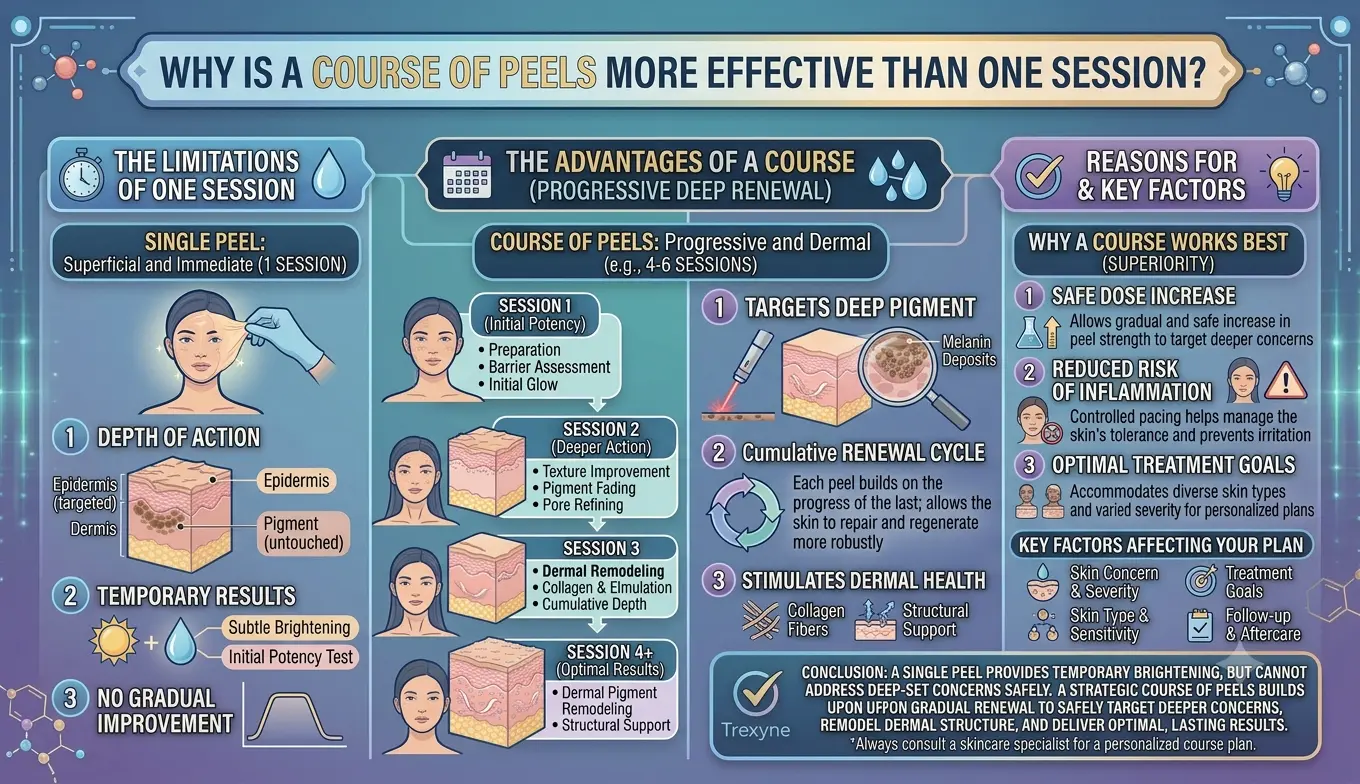
Why Is a Course of Peels More Effective Than One Session?
A course of peels is more effective than a single session because skin renewal happens in stages, not all at once. One treatment can start the process, but it takes repeated sessions to build visible, lasting change in tone and texture. This is why most practitioners recommend a structured programme rather than a one-off appointment when working with the Trexyne Peel. Its tiered protocol is specifically designed around this idea, allowing intensity to be adjusted across several visits so that each session builds on the last, rather than trying to achieve everything in one go.
Clients often ask whether a single, more intensive treatment could achieve the same outcome as a course. Understanding why the answer is almost always no requires a closer look at how skin actually renews itself, and why a paced, professional programme tends to produce more even, more predictable results.
This question comes up frequently during consultations, particularly from clients who are used to treatments that offer instant, visible change. Taking the time to explain the biology behind skin renewal, and how a tiered protocol works with that biology rather than against it, tends to make the reasoning behind a course-based approach much clearer.
How Skin Renewal Actually Works
Skin is not a static surface that changes the moment it is treated. It is a living, layered structure that regenerates on its own natural cycle, with new cells forming at the base of the epidermis and gradually moving upward to replace the cells at the surface. This process typically takes several weeks to complete, and it tends to slow down with age, sun exposure, and general environmental stress on the skin barrier.
A single resurfacing session can encourage this renewal process, but it cannot compress weeks of biological activity into one appointment. This is simply how skin works, regardless of how the treatment is delivered. Understanding this timeline is essential to understanding why a course, rather than a single visit, tends to produce more meaningful results.
Why One Session Only Tells Part of the Story
A single treatment can absolutely create a noticeable improvement, particularly in surface texture. However, because the skin’s renewal cycle continues well beyond the appointment itself, one session only captures the very beginning of that process. The more significant, longer-lasting changes in tone and texture tend to develop as the skin completes several renewal cycles, which is exactly what a course of sessions is designed to support.
The Cumulative Effect of Repeated Treatments
One of the clearest reasons a course outperforms a single session is the cumulative nature of skin renewal. Each treatment builds on the physical changes encouraged by the one before it, gradually refining texture and evening out tone over time.
Building on Previous Progress
Rather than starting from scratch at every appointment, a course allows each session to reinforce what has already been achieved. This layered approach tends to produce smoother, more consistent results than trying to achieve the same outcome through a single, more intense treatment.
Avoiding the Risk of Overcorrection
Attempting to achieve dramatic results in one sitting can also mean pushing intensity higher than the skin is genuinely ready for, simply to compensate for the lack of repeated sessions. A tiered protocol avoids this by spreading intensity across multiple visits, which tends to be more comfortable for the client and more predictable for the practitioner.
Why a Tiered Protocol Matters
The Trexyne Peel is built around a tiered protocol that lets practitioners match treatment intensity to skin type and client expectation. This structure is specifically designed to support a course-based approach, rather than a single, fixed-intensity session.
Matching Intensity to the Individual
No two clients have identical skin, so a tiered approach allows practitioners to start conservatively and adjust intensity as they learn how a particular client’s skin responds. This is difficult to achieve properly in a single appointment, since there is no opportunity to observe recovery and adjust the plan accordingly.
Adjusting the Plan as You Go
Because the mechanism behind the Trexyne Peel is mechanical, using marine-algae spicules to create controlled micro-channels rather than relying on chemical exfoliants, practitioners have a tangible, physical variable they can adjust from one session to the next. This makes it straightforward to increase or reduce intensity in a controlled way as a course progresses, something that simply is not possible within a single visit.
Predictable Downtime Across a Programme
A tiered protocol also supports predictable downtime, which matters just as much as visible results when planning treatment around a client’s lifestyle. Spreading a treatment plan across several sessions, each with manageable downtime, tends to be more practical for most clients than attempting one longer, more intensive session with a longer recovery period.
Comparing a Single Session to a Structured Course
It can help to look directly at what each approach realistically offers, since the differences explain why a course tends to be recommended over a one-off treatment.
What a Single Session Can Achieve
A single session with the Trexyne Peel can encourage an initial improvement in surface texture and may leave skin feeling smoother in the days that follow. However, because skin renewal is a gradual process, this improvement is often modest and can fade back toward baseline once the immediate effects of the treatment settle.
What a Course Can Achieve
A course of sessions allows the skin to move through several renewal cycles under professional guidance, with intensity adjusted along the way. This tends to produce a more visible, more even-looking improvement in tone and texture, and the results are generally more resilient over time because they reflect genuine renewal rather than a temporary surface effect.
Why the Gap Widens Over Time
The difference between a single session and a full course tends to become more apparent as time goes on. A single treatment’s effects may soften within a few weeks, while a properly paced course builds a more durable improvement that clients continue to notice well after their final appointment.
This is worth explaining clearly to clients who are comparing the upfront cost of a single session against a full programme. While a course represents a greater initial investment of time and commitment, the more lasting nature of the results it produces is often what makes the difference between a treatment that feels worthwhile and one that leaves a client wondering why the improvement did not last.
The Role of Vitamin E in Supporting a Course-Based Approach
The Trexyne Peel is infused with stabilised tocopherol, a form of Vitamin E that supports the skin’s recovery phase from the very first application. This matters particularly in the context of a course, since consistent support for the skin’s recovery process between sessions helps the skin arrive at each subsequent appointment in a more settled state.
Supporting Comfort Between Sessions
Because Vitamin E is built into the treatment itself, rather than needing to be applied separately as part of aftercare, clients benefit from consistent support at every stage of their course. This can make the overall experience more comfortable, which in turn makes it easier for clients to stay committed to a full programme rather than dropping out after one or two sessions.
Why Consistency Across a Course Matters
Supporting recovery is not just about comfort immediately after treatment. It also plays a role in how well the skin is prepared for the next session in the course. Skin that has recovered well tends to respond more predictably to the next stage of treatment, which supports a smoother overall progression through the programme.
Setting Realistic Expectations for a Course
Explaining clearly why a course outperforms a single session is an important part of any consultation. Clients who understand the reasoning behind a structured programme are more likely to commit to it fully, which in turn supports better results.
Discussing the Full Timeline Upfront
Rather than framing each session as a standalone event, practitioners should present the course as a single, connected programme from the outset. This helps clients understand that the value of the plan lies in its cumulative effect, not in any one individual appointment.
Using Photographs to Demonstrate Progress
Consistent photographic tracking, taken before each session under similar lighting conditions, is one of the most effective ways to demonstrate the value of a course. Clients can often see for themselves how much more noticeable the changes are by the middle or end of a programme compared to how they looked after their very first session.
Managing Expectations Around Events
Clients preparing for a wedding, holiday, or other important date sometimes hope a single session close to the date will be enough. Explaining that a course, started well in advance, is far more likely to deliver visible results by the date in question helps avoid disappointment and encourages better planning.
Why Skipping Sessions Undermines the Approach
Because a course relies on cumulative, staged renewal, skipping sessions or leaving excessive gaps between appointments can undermine the overall plan. Understanding why consistency matters helps both practitioners and clients stay committed to the full programme.
The Impact of Long Gaps
If too much time passes between sessions, the skin’s renewal cycle may complete and begin to plateau before the next treatment is applied, meaning some of the momentum built earlier in the course is lost. This does not mean the earlier sessions were wasted, but it does mean the overall course may take longer to reach its intended outcome.
Rebuilding Momentum After a Break
If a client does need to pause a course, practitioners can usually reassess intensity at the next appointment to help rebuild momentum. This is another advantage of a tiered protocol, since it allows the plan to be adapted rather than requiring the client to start again from the very beginning.
Long-Term Maintenance After a Full Course
Once a client has completed an initial course of the Trexyne Peel, many choose to move onto a periodic maintenance schedule rather than stopping treatment altogether. This approach helps preserve the results built up over the course without requiring the same frequency of appointments.
Why Maintenance Sessions Differ From the Initial Course
Maintenance sessions typically serve a different purpose than the sessions within an initial course. Rather than building new renewal from a lower starting point, maintenance sessions are designed to sustain results that have already been achieved, which often means they can be spaced further apart.
Building a Long-Term Relationship With a Practitioner
Viewing the Trexyne Peel as part of an ongoing renewal routine, rather than a single transaction, tends to support better long-term outcomes for clients. Practitioners can review the complete range of professional treatment options through the Trexyne shop, and clinics considering how to structure their own course-based offering are welcome to get in touch through the Trexyne contact page. More information on the brand’s overall approach to professional skin renewal is available on the Trexyne homepage.
Why Practitioners Recommend a Course From the Outset
Experienced practitioners rarely recommend a single session as a standalone treatment, precisely because they understand how skin renewal works. Recommending a course from the first consultation reflects a genuine understanding of what will produce the best outcome for the client, rather than simply offering the easiest or quickest option.
Educating Clients on the Reasoning
Part of a practitioner’s role is helping clients understand why a course-based approach serves their interests better than a single session, even if it requires a greater initial commitment. Clients who understand this reasoning tend to be more satisfied with their results and more likely to return for future maintenance sessions.
The Professional Case for Structured Programmes
From a clinical perspective, a structured course also allows practitioners to observe and document how an individual client’s skin responds over time. This creates a more informed basis for any future treatment decisions, whether that means adjusting a maintenance schedule or planning a new course to address a different concern.
Common Misconceptions About Single-Session Treatments
Several misconceptions tend to come up when clients weigh the idea of a single treatment against a full course. Addressing these directly during a consultation can help set more realistic expectations from the outset.
The Idea That More Product Equals More Results
Some clients assume that using a higher intensity in one session is simply a more efficient way to reach the same outcome as a course. In reality, skin can only respond to and recover from a certain level of stimulation at any one time. Increasing intensity beyond what the skin can comfortably manage does not accelerate renewal, it simply increases the demands placed on recovery, often without a proportional improvement in results.
Believing Results Should Be Immediate
Because many other cosmetic treatments are associated with instant, visible change, clients sometimes expect the same from a resurfacing treatment. Skin renewal simply does not work this way. The most meaningful improvements in tone and texture tend to appear gradually, which is precisely why a paced course tends to outperform a single appointment when it comes to lasting results.
Assuming One Session Is a Fair Trial of the Treatment
Clients occasionally treat a single session as a test of whether the Trexyne Peel works for them, expecting to see a full result before committing to further sessions. Since one treatment only represents the earliest stage of a much longer renewal process, judging the treatment on this basis alone does not give a fair or complete picture of what a properly planned course can achieve.
How Practitioners Explain the Value of a Course
Communicating the reasoning behind a course-based approach is often just as important as the treatment itself. Clients who understand why a structured plan works better tend to feel more confident about committing to it.
Framing the Course as a Journey, Not a Transaction
Rather than presenting each appointment as a separate purchase, practitioners can frame the course as a connected journey toward a specific outcome. This shift in framing helps clients see the value of the full programme, rather than judging each session in isolation.
Using Simple, Relatable Explanations
Comparing skin renewal to something clients already understand, such as how the body needs time to heal after any kind of physical activity, can make the concept of gradual, cumulative improvement easier to grasp. Straightforward analogies like this tend to land better than technical explanations, particularly for clients who are new to professional skin treatments.
Reinforcing the Message at Every Session
Reminding clients briefly at each appointment about how their course is progressing, and what to expect at the next stage, helps reinforce the value of the overall plan. This ongoing communication also gives practitioners the opportunity to address any concerns before they affect a client’s commitment to finishing the course.
The Financial and Practical Case for a Course
Beyond the biological reasoning, there is also a practical case for a course-based approach. Clients considering their options often find that thinking in terms of a full programme, rather than a single appointment, makes more sense both for their skin and for their overall plan.
Comparing the Value of a Course Versus Repeated Single Visits
Booking several individual sessions without a structured plan can sometimes lead to inconsistent spacing and intensity, since there is no overarching framework guiding the decisions made at each visit. A properly planned course avoids this by setting out the intended structure from the beginning, even if some flexibility is built in along the way.
Planning Around Life Events With a Course in Mind
Because a course requires forward planning, clients preparing for a specific event are encouraged to think about their treatment timeline well in advance. Starting a course several weeks or months ahead of an important date allows enough time for the skin to move through several renewal cycles, rather than relying on a single session close to the date itself.
What Practitioners Look for When Reviewing a Course
Throughout a course of treatments, practitioners are not simply repeating the same session on a schedule. Each appointment is an opportunity to review how the skin has responded and to make any necessary adjustments to the plan.
Reviewing Recovery From the Previous Session
Before beginning the next treatment, practitioners typically check in on how the skin recovered from the last session, including how comfortable the client felt during the days that followed. This information helps guide any adjustments to intensity for the upcoming session.
Adjusting Spacing Where Needed
If a client’s skin needs a little longer to recover than expected, spacing between sessions can be extended without compromising the overall course. This flexibility is one of the key advantages of a tiered, course-based approach compared to attempting to achieve results in a single, fixed appointment.
Documenting Progress for Future Reference
Keeping simple notes on intensity, recovery, and visible progress at each stage of a course creates a useful reference for future maintenance sessions. This means that even after the course has finished, a practitioner has a clear record of what worked well for that particular client, making it easier to plan any future treatment with confidence.
Why This Approach Reflects Good Clinical Practice
Recommending a course over a single session is not simply a matter of preference, it reflects a genuine understanding of how skin renewal works and how to support it responsibly. A practitioner who takes the time to explain this reasoning is demonstrating a commitment to results that last, rather than offering a quick fix that may not hold up over time.
Balancing Client Expectations With Realistic Outcomes
Part of good clinical practice involves balancing what a client hopes to achieve with what is realistically achievable within a safe, comfortable treatment plan. A course-based approach allows practitioners to work toward ambitious goals gradually, without placing unnecessary strain on the skin in pursuit of faster results.
Supporting Long-Term Skin Health Alongside Visible Results
A well-planned course does more than simply improve the appearance of the skin in the short term. By working with the skin’s natural renewal cycle rather than against it, this approach also supports the overall health and resilience of the skin over the longer term, which is ultimately what most clients are looking for when they commit to a course of professional treatment.
Conclusion
A single peel session can offer an initial improvement, but it only captures the beginning of what is a much longer natural renewal process. A course of sessions allows this process to build cumulatively, with intensity adjusted along the way to suit the individual’s skin. Because the Trexyne Peel works through a mechanical mechanism using marine-algae spicules, supported by stabilised Vitamin E for the skin’s recovery phase, its tiered protocol is specifically designed to support this staged, course-based approach. Over a properly planned course, clients may see a brighter, more even-looking complexion develop gradually, with results that tend to be more consistent and longer-lasting than those achieved through a single treatment alone.
Frequently Asked Questions
Q: Why can’t I get the same results from one peel session as I would from a full course?
A single session can only capture the earliest stage of skin renewal, which is a gradual process that unfolds over several weeks. A course allows this renewal to build cumulatively across multiple sessions, producing more visible and consistent results.
Q: How many sessions are usually included in a course of peels?
This depends on the individual and the concern being treated, though many practitioners plan courses across a run of several sessions, adjusting intensity as the skin responds at each stage.
Q: Will one strong peel session give faster results than several gentler ones?
Not necessarily. Pushing intensity higher in a single session does not replace the benefit of allowing the skin to renew gradually across a properly spaced course, and it may increase discomfort without improving the overall outcome.
Q: What happens if I skip sessions partway through a course?
Skipping sessions can slow progress, since the skin’s renewal cycle may plateau before the next treatment is applied. A practitioner can usually reassess and adjust the plan to help rebuild momentum.
Q: How soon will I notice a difference after starting a course of peels?
Some clients notice smoother texture after the first session, though more visible changes in tone and texture typically build gradually across the course as intended.
Q: Do I need to continue with treatments after finishing my first full course?
Many clients move onto a periodic maintenance schedule after completing their initial course, spaced further apart, to help sustain the results already achieved.
Q: Is a course of peels suitable for all skin types?
Because the protocol is tiered, intensity can be matched to individual skin types and sensitivity levels, which allows practitioners to structure a course suited to a wide range of skin types.