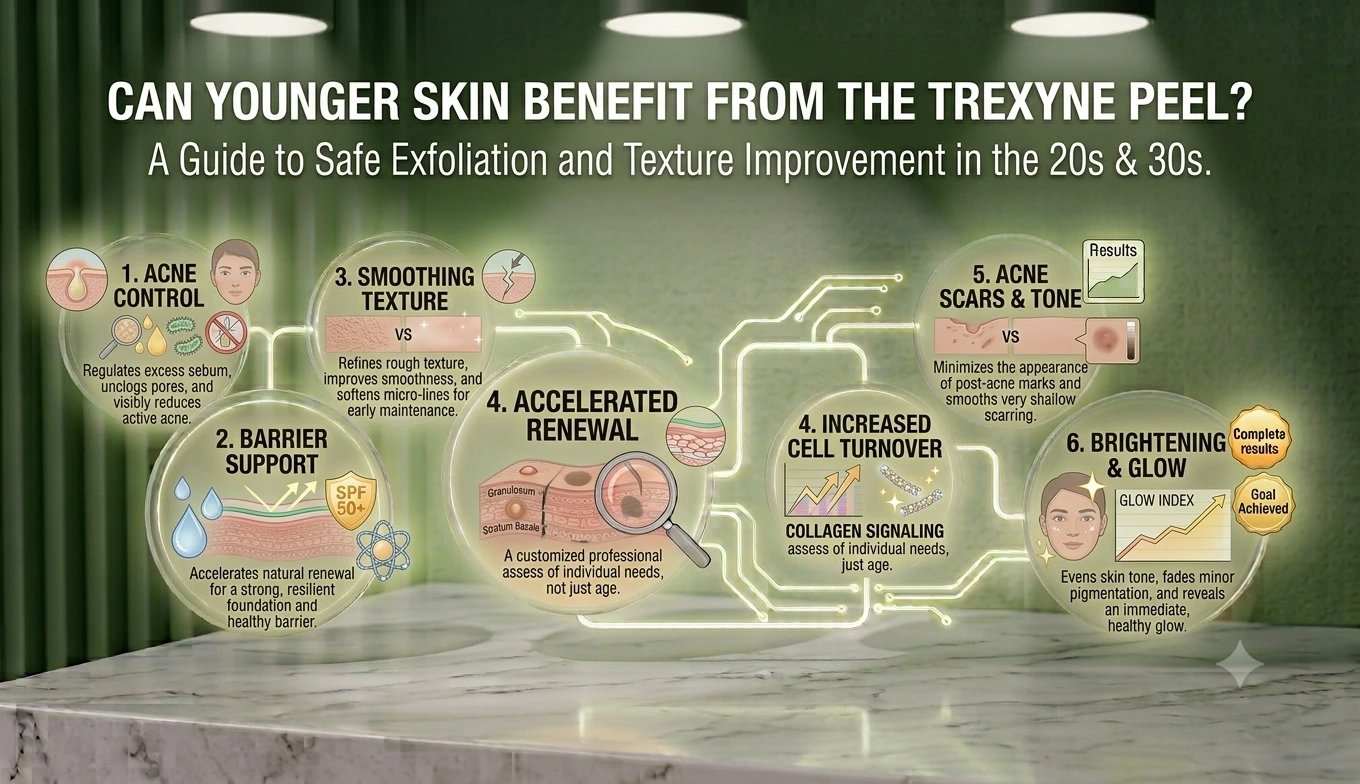
Can Younger Skin Benefit From the Trexyne Peel?
Resurfacing treatments are often associated with mature skin, but younger clients increasingly ask whether treatments like this suit their skin too. The honest answer is that suitability depends far more on individual skin condition and goals than on age alone. Because the Trexyne Peel works through a mechanical mechanism with a tiered protocol, practitioners can tailor intensity to a wide range of skin presentations, including the congestion, texture concerns, and early skin renewal goals that often bring younger clients into clinic. This article looks at what younger skin typically needs, how the tiered protocol supports that, and how a proper consultation guides whether and when treatment is appropriate.
Understanding What “Younger Skin” Means in Aesthetic Practice
“Younger skin” is not a single category. A client in their early twenties may be dealing with active congestion and uneven texture, while a client in their late twenties or early thirties might be noticing the very earliest signs of dullness or unevenness. Skin condition, rather than age on its own, is what determines whether a resurfacing treatment is a sensible option.
Practitioners are used to looking past age as a number and instead assessing what is actually happening at the skin’s surface. This is exactly the approach taken with Trexyne Peel, where the tiered protocol allows treatment to be matched to the individual rather than applied uniformly based on assumptions about age.
Why This Distinction Matters
Treating skin according to its actual condition, rather than a client’s date of birth, leads to far more appropriate outcomes. A younger client with resilient, well-hydrated skin may tolerate a different intensity than an older client with the same concern, and vice versa. This is why consultation remains central to every Trexyne Peel session, regardless of the client’s age.
It also means practitioners should resist making assumptions before a client has even sat down for consultation. A client in their early twenties might arrive expecting to be told they are “too young” for a resurfacing treatment, when in fact their specific concerns, such as persistent congestion or textural unevenness, are exactly the kind of thing the tiered protocol is designed to accommodate. Approaching every consultation with an open mind, rather than a preconceived idea based on age, tends to produce better outcomes for everyone involved.
How Trexyne Peel’s Mechanical Mechanism Suits Different Skin Ages
Trexyne Peel is not a chemical peel. It contains no acids and works through a purely mechanical mechanism, using marine-algae spicules to create controlled micro-channels across the skin’s surface. Because this mechanism does not rely on chemical exfoliation, its effect can be adjusted through technique and protocol tier rather than through the strength of a chemical solution.
This adaptability is one of the reasons Trexyne Peel can suit a broad range of skin presentations. Rather than a fixed-strength formulation that may be too intense for some clients and insufficient for others, the mechanical approach allows practitioners to scale the treatment to what the skin in front of them actually needs.
A Flexible Approach Across Skin Presentations
Younger skin often responds differently to resurfacing than more mature skin, sometimes tolerating treatment well due to naturally higher cell turnover, though this varies considerably between individuals. The tiered protocol means practitioners are not locked into a single approach, which is particularly useful when working with younger clients who may have very different skin needs from one another despite being similar in age.
Two clients in their mid-twenties, for example, might present very differently at consultation. One might have resilient, well-hydrated skin with mild textural concerns, while another might have more reactive skin still adjusting to changes in their skincare routine or hormonal balance. Treating both clients identically would not make sense, and the tiered structure of Trexyne Peel gives practitioners the flexibility to respond to what each individual actually needs, rather than applying a single standard protocol across the board.
Common Concerns Younger Clients Bring to Consultation
Younger clients booking a consultation for Trexyne Peel often raise concerns that differ from those typically associated with more mature skin. Congestion, uneven texture, and the aftermath of active or previous breakouts are common themes, alongside a general interest in supporting skin renewal before more visible concerns develop.
Congestion and Textural Irregularities
Many younger clients are dealing with ongoing congestion, roughness, or an uneven surface texture caused by a combination of factors including skincare habits, hormonal changes, and lifestyle. These concerns are often less about visible ageing and more about wanting the skin’s surface to feel smoother and look more refined.
Early Interest in Preventative Skincare
A growing number of younger clients are simply curious about supporting their skin’s renewal process before concerns become more pronounced. This preventative mindset has become increasingly common, and it is a legitimate reason for a consultation, even if treatment ultimately proves unnecessary or unsuitable at that particular time.
This shift is worth acknowledging rather than dismissing. Clients who are engaged with their skin health early tend to be well informed and genuinely interested in understanding how a treatment works before committing to it. Taking the time to explain the mechanical mechanism behind Trexyne Peel, and being clear about what it can and cannot realistically offer, tends to be well received by this type of client, who often appreciates a straightforward, unembellished explanation over a heavily marketed one.
Why the Tiered Protocol Matters for Younger Skin
The tiered protocol built into Trexyne Peel is particularly relevant when working with younger clients, since it allows the practitioner to start conservatively and adjust based on how the skin responds. This is a sensible approach for any new client, but it carries extra weight for younger skin, which may not have been exposed to professional resurfacing treatments before.
Starting with a lighter tier allows the practitioner to assess tolerance and response before considering whether a stronger protocol is appropriate for future sessions. This measured approach supports predictable downtime and reduces the likelihood of the skin feeling overwhelmed by an intensity that was not well matched to its current condition.
Building a Treatment Plan Gradually
Rather than committing to a single intensive session, many practitioners prefer to build a treatment plan gradually with younger clients, beginning with lighter tiers and reassessing after each appointment. This allows the relationship between practitioner and client to develop alongside the treatment plan itself, with adjustments made based on real feedback rather than assumptions.
This gradual approach also gives the practitioner a clearer picture of how a client’s skin responds over time, rather than making a single judgement based on one initial assessment. A client’s skin can change between sessions due to seasonal factors, changes in routine, or simply the natural variation that occurs over weeks and months. Reassessing at each appointment, rather than following a fixed plan set at the very first consultation, keeps the treatment genuinely responsive to what the skin needs at that point in time.
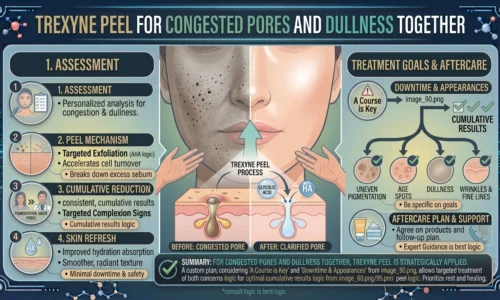
Can Trexyne Peel Help With Congestion and Uneven Texture?
Trexyne Peel’s mechanical mechanism, using marine-algae spicules to create controlled micro-channels, is designed to resurface and refine the skin’s surface. For clients dealing with congestion or textural irregularities, this mechanical resurfacing action may help support a smoother, more refined appearance over a course of treatments.
It is important to be clear that Trexyne Peel is not marketed as a treatment for any specific skin condition, and outcomes will vary between individuals. What can be said is that the treatment supports skin renewal through its mechanical action, and many clients pursuing improved texture find this an appropriate option to discuss during consultation.
Setting Realistic Expectations
As with any resurfacing treatment, results build gradually across a course of sessions rather than appearing after a single appointment. Being upfront about this with younger clients, who may be eager for quick results, helps set realistic expectations from the outset and supports a more positive overall experience. Clients weighing up a single session against a course of treatments can review the available pricing and package options via the Trexyne shop when planning ahead.
Supporting Skin Renewal Before Visible Ageing Begins
Some younger clients are drawn to Trexyne Peel not because of an existing concern, but because they are interested in supporting their skin’s natural renewal process proactively. Trexyne resurfaces, refines, and supports skin renewal through its mechanical mechanism, which can appeal to clients who want to establish good skin habits early rather than waiting until concerns become more visible.
This kind of proactive approach should always be balanced against genuine need. Not every younger client requires resurfacing treatment, and part of a practitioner’s role is to have an honest conversation about whether treatment is appropriate at that stage, or whether a simpler skincare routine would serve the client just as well for now.
A Practitioner’s Role in Managing Expectations
Being willing to say that a client does not yet need treatment, or that a lighter, less frequent protocol is more appropriate, builds long-term trust. Clients who feel they are being guided honestly, rather than simply sold a treatment, are far more likely to return when their skin’s needs genuinely call for it.
Vitamin E’s Role in Supporting Younger Skin’s Recovery
Trexyne Peel is infused with stabilised Vitamin E, which supports the skin’s recovery phase from the first application. This is relevant for clients of any age, but it is worth explaining clearly to younger clients who may not be familiar with why this ingredient matters within the treatment.
Supporting the skin’s natural recovery process helps the skin settle more comfortably after the mechanical resurfacing process, regardless of the client’s age. Because this support begins with the very first session, younger clients starting a course of treatments benefit from this from their earliest appointment onwards.
Why This Matters for First-Time Clients
Many younger clients booking Trexyne Peel are having a professional resurfacing treatment for the first time. Knowing that the treatment includes built-in support for the skin’s recovery phase can be reassuring, particularly for clients who are naturally a little apprehensive about trying a new treatment for the first time.
What a Consultation for a Younger Client Looks Like
A thorough consultation is essential before booking any Trexyne Peel session, and this is especially true for younger clients who may be newer to professional treatments generally. The consultation should cover current skincare routine, any relevant skin history, specific concerns, and realistic goals for a course of treatment.
Practitioners should also use this time to explain the tiered protocol clearly, describing how a lighter starting tier allows for a measured introduction to the treatment. Clients who are unsure whether Trexyne Peel is right for them are welcome to get in touch through the Trexyne contact page to discuss their skin and ask any questions before committing to an appointment.
Questions Worth Asking During Consultation
Useful questions include what the client hopes to achieve, whether they have had any professional skin treatments before, and how their skin has typically responded to new products or routines in the past. These answers help shape a sensible starting tier and treatment plan.
It is also worth asking about lifestyle factors that may influence skin condition, such as sun exposure, stress levels, and sleep patterns, since these can all play a part in how younger skin presents. Taking the time to understand the full picture, rather than focusing narrowly on the skin’s surface alone, generally leads to a more considered and appropriate recommendation.
When It Might Be Better to Wait
Not every younger client is a suitable candidate for Trexyne Peel at the time they book a consultation. Active skin conditions, certain medications, or skin that is currently compromised or highly reactive may mean it is more sensible to wait, or to address underlying concerns first before considering resurfacing treatment.
A good practitioner will always be honest in these situations, even if it means turning a client away or recommending they return at a later date. This kind of honesty supports both client safety and long-term trust in the practitioner’s judgement.
Recognising When Treatment Should Be Postponed
Signs that treatment might need to wait include current breakouts that are still active and inflamed, recent sun exposure or sunburn, or any skin condition that has not yet been properly assessed. A careful, unhurried consultation gives the practitioner the information needed to make this call confidently.
It is also worth remembering that postponing treatment is not a failure on the client’s part, nor should it be framed that way. Explaining clearly why waiting is the more sensible option, and offering a realistic timeframe for revisiting the conversation, helps the client understand the decision as a considered clinical judgement rather than a rejection. Most clients respond well to this kind of honesty and are more likely to return once the practitioner’s recommendation has been followed.
Why Professional Assessment Matters More Than Age Alone
Trexyne Peel is sold strictly to verified practitioners and clinics, which means every session begins with professional assessment rather than a generic, one-size-fits-all approach. This matters enormously when working with younger clients, since age alone tells a practitioner very little about what a particular client’s skin actually needs.
This professional-only structure ensures that decisions about suitability, tier selection, and treatment frequency are always guided by trained clinical judgement. For clinics interested in offering Trexyne Peel to clients across a range of ages, further information is available via the Trexyne homepage, including details on becoming a verified practitioner.
Conclusion
Younger skin can benefit from Trexyne Peel, but suitability always comes down to individual skin condition rather than age alone. Because the treatment works through a mechanical mechanism with a genuinely tiered protocol, practitioners can tailor intensity to congestion, uneven texture, or a client’s simple interest in supporting skin renewal proactively. A thorough consultation remains essential for every client, ensuring treatment is only recommended when it is genuinely appropriate. For younger clients whose skin would benefit from a measured, professionally guided approach, Trexyne Peel can support a smoother, brighter, more even-looking complexion over a considered course of treatments.
FAQs
Q: Is Trexyne Peel suitable for skin in your twenties?
Suitability depends on individual skin condition rather than age alone. Many younger clients dealing with congestion or uneven texture find the tiered protocol allows treatment to be matched appropriately to their skin during consultation.
Q: Can Trexyne Peel help with congestion in younger skin?
Trexyne Peel’s mechanical resurfacing mechanism may help support a smoother, more refined skin surface over a course of treatments. Results vary between individuals, and a consultation helps determine whether this is an appropriate option.
Q: Do you need to wait until you notice signs of ageing to try Trexyne Peel?
No. Some clients choose Trexyne Peel to proactively support their skin’s renewal process, though a consultation will always assess whether treatment is genuinely needed at that stage.
Q: Is a lighter tier recommended for first-time younger clients?
Many practitioners start younger, first-time clients on a lighter tier of the protocol, allowing skin tolerance and response to be assessed before considering a stronger approach in future sessions.
Q: Can teenagers have Trexyne Peel treatment?
Trexyne Peel is a professional treatment applied exclusively by trained practitioners, who assess every client individually during consultation. Any questions about suitability for a specific age or skin type should be discussed directly with a verified practitioner.
Q: How does Vitamin E in Trexyne Peel support younger skin?
The stabilised Vitamin E infused into Trexyne Peel supports the skin’s recovery phase from the very first application, helping the skin settle comfortably after treatment regardless of the client’s age.
Q: What should a younger client expect during a Trexyne Peel consultation?
A consultation typically covers current skincare routine, skin history, specific concerns, and treatment goals. This helps the practitioner recommend an appropriate starting tier and confirm whether treatment is suitable at that time.